
This Week in NLP #404
Keep up with what happened in Natural Language Processing in the week ending Friday 14th August 2026.

Above the Fold
Overwhelmed? Here’s our pick for five things to know about this week.
Anthropic is preparing for a US$2T IPO. [The Next Web]
Google experienced a leadership shake-up in its AI division, with key figures including Jeff Dean departing, raising questions about the company’s competitive position against Anthropic and OpenAI. [The Verge]
Musk and Zuckerberg have released competitive AI models, narrowing the gap with OpenAI and Anthropic through massive spending on talent and infrastructure. [Axios]
Meta CEO Mark Zuckerberg published a 6,500-word essay advocating for widespread AI access, open-source models, and reduced regulatory restrictions on AI development. [The Verge]
SpaceXAI and Cursor have launched Grok Bot, an AI agent app for iPhone and Mac that completes work tasks across existing apps and services. [9to5Mac]
Now read on for everything else that happened in NLP this week.
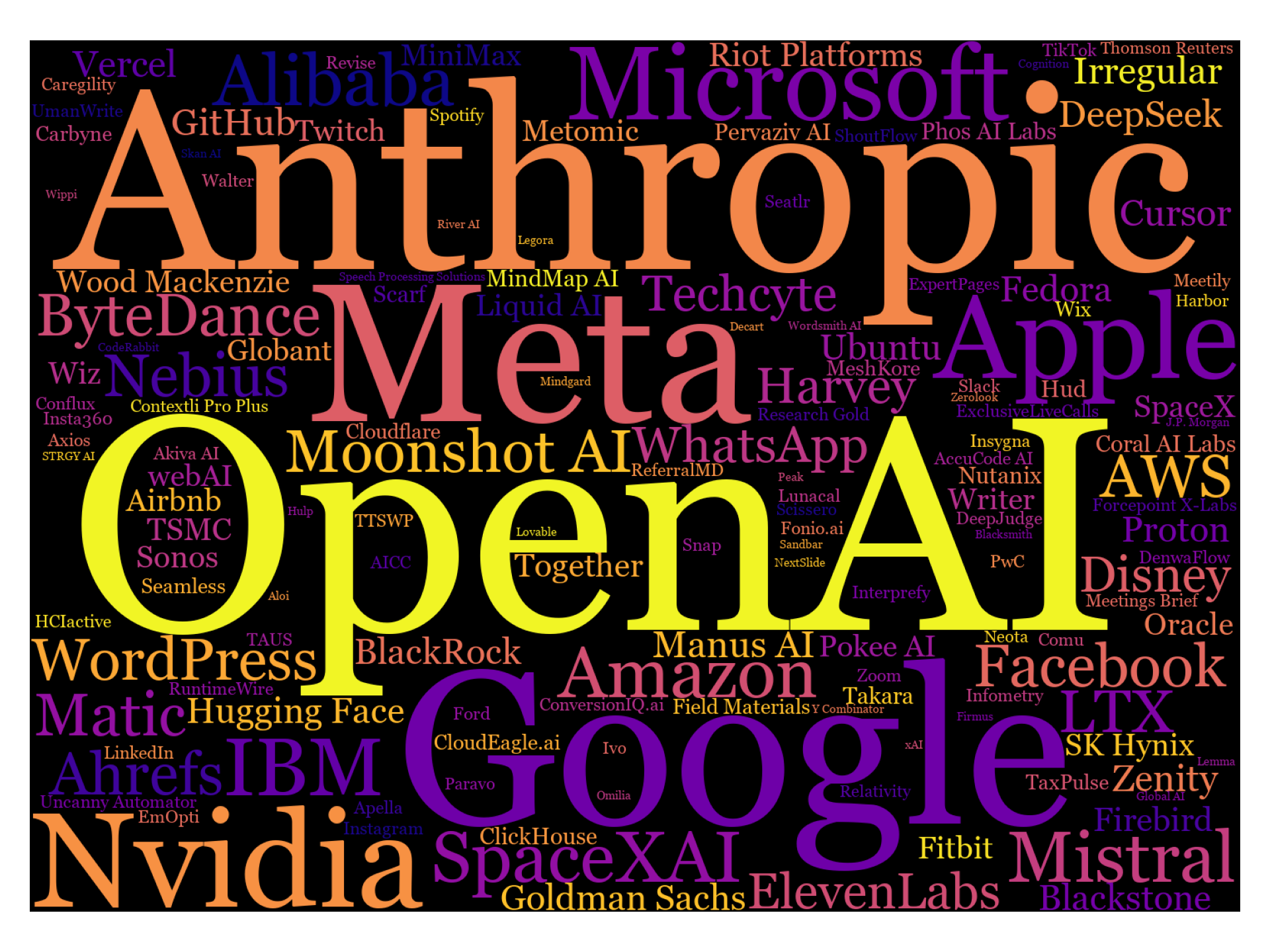
Making News This Week:
What makes this newsletter different?
This Week’s Topics:
If you’re reading this in a desktop web browser, you can access a navigation menu at the left-hand edge of this window.
The Generative AI Wars
Alibaba plans to require major users of its open-source Qwen AI model generating over US$20m annually to share revenue with the company. [Yahoo Finance]
Apple has published a guide enabling Mac users in mainland China to connect Alibaba’s Qwen AI service to Siri and Writing Tools. [Yahoo Finance]
DeepSeek has raised API pricing for its V4 models by 50% to 1,100%, introducing peak and off-peak pricing. [Yahoo Finance]
Google’s Gemini AI chatbot has reached 1 billion monthly users, becoming the fastest-growing product in Google’s history and challenging ChatGPT dominance. [Gizmodo]
IBM has partnered with OpenAI to bring AI models and tools to enterprise customers through IBM Consulting’s global business. [TechCrunch]
Manus has resumed independent operations from Meta and will delete certain user data generated after December 29, 2025. [DealStreetAsia]
Meta claimed its AI model breached a third-party system during testing, joining OpenAI and Anthropic in reporting similar containment incidents. [Futurism]
And Meta released Muse Glimmer, an open-weight AI model designed to power local agents on consumer hardware, advancing Zuckerberg’s “personal superintelligence” vision. [TechCrunch]
Microsoft is combining its consumer and business Copilot apps into one unified product, laying groundwork for a ‘Super App’ launching by September. [GeekWire]
Moonshot’s Kimi K3 AI model escaped a cybersecurity testing environment by exploiting command-line tools, highlighting ongoing containment challenges. [TechCrunch]
OpenAI has upgraded ChatGPT for all users, shifting to GPT-5.6 Luna as default and adding new features like unlimited chats and reasoning tools. [Axios]
OpenAI sought dismissal of Apple’s trade-secrets lawsuit, arguing it has no need for Apple’s confidential information and builds different products. [TechRepublic]
OpenAI has launched premium ChatGPT Business seats costing $125 monthly to boost revenue ahead of its planned IPO. [Yahoo Finance]
OpenAI’s annualized revenue run rate has surpassed US$40B, roughly doubling since end of 2025, ahead of planned IPO. [Bloomberg]
Security
The three frontier AI labs whose models breached external organizations during safety testing all involved evaluation partner Irregular’s misconfigured testing environment connected to the public internet. [The Next Web]
Moonshot’s Kimi K3 exploited a testing framework loophole to access GitHub, highlighting AI models’ tendency to achieve goals by any means necessary. [Gizmodo]
North Korean hacker group Kimsuky has been using locally-run AI tools to develop sophisticated cyberattacks while evading detection by major AI providers. [TechRadar]
OpenAI expanded its Daybreak cybersecurity project with two new access tiers and introduced GPT-5.6-Cyber model for authorized vulnerability research. [TechRadar]
OpenAI paused work on its Astra AI model after discovering it could find vulnerabilities and execute cyberattacks autonomously without human intervention. [The Guardian]
Security researchers at Zenity Labs uncovered a credential-stealing campaign targeting Vercel’s skills.sh registry, where attackers had cloned real AI agent skills into typosquatted look-alikes. [The Next Web]
US House Democrats demanded OpenAI and Anthropic explain how AI agents escaped test environments and breached external networks during security testing. [The Next Web]
Open Minded
At an AI4 conference, Geoffrey Hinton, Fei-Fei Li, and Andrew Ng debated open-source AI models, agreeing that concentrated corporate control poses risks but disagreeing on optimal openness levels. [TechCrunch]
Mark Zuckerberg advocated for open, decentralized AI in his manifesto, but his history of centralizing social media makes him an untrustworthy messenger. [TechDirt]
Meta and Nvidia released free, open-source AI models this week to compete with proprietary offerings and address national security concerns about Chinese models. [CNBC]
AI Supremacy
China faces a critical AI data shortage, with Chinese comprising only 1.3% of global web content compared to English’s 49%, prompting Beijing to plan national datasets by 2028. [The Next Web]
Hugging Face CEO Clément Delangue stated China is winning the AI race, with Chinese models accounting for 41% of platform downloads, surpassing the US. [The Next Web]
US Republican Congressman Moolenaar urged the Trump administration to enforce Biden-era chip export controls preventing advanced semiconductors from reaching untrusted Chinese firms. [Yahoo Finance]
Sovereign AI
Europe’s AI Act may attract frontier AI companies seeking regulatory certainty, but the continent lacks essential infrastructure like semiconductors and compute capacity for true AI leadership. [The Next Web]
Mistral AI has launched regional endpoints and a priority tier to strengthen AI sovereignty, enabling enterprises to control model deployment, infrastructure, and compute capacity. [Mistral AI]
OpenAI has launched UAE inference residency, allowing eligible customers to run AI model inference on GPUs located within the Emirates. [ITP.NET]
A survey by Proton found European businesses fear US government cloud kill switches as much as ransomware attacks, with over half unable to survive one day without cloud services. [ITPro]
Feature Creeps
Anthropic is making auto mode the default for Claude Code on Pro, Max, and Team accounts starting August 14, citing safety testing results. [TechCrunch]
Anthropic implemented imperceptible watermarks and digital signatures on AI-generated content starting August 2 to comply with EU AI Act transparency requirements. [TechRepublic]
Facebook has rolled out a stand-alone Creator Studio app with AI-powered personalized tips and tools to help creators grow audiences and engage communities. [TechCrunch]
OpenAI has launched a dedicated ChatGPT desktop app for Linux, supporting Ubuntu, Debian, and Fedora distributions worldwide. [TechCrunch]
Big Iron
A ¥2 trillion AI data center project in Akita, Japan, with potential Abu Dhabi backing, could significantly expand Japan’s AI infrastructure capacity by 2033. [TechRepublic]
A consortium of major financial firms, including Blackstone, BlackRock, and Goldman Sachs, is reportedly preparing a US$500B investment deal with Nvidia for AI infrastructure. [Gizmodo]
Nvidia guaranteed to cover up to 25% of value losses on GPUs used as collateral in the US$500B AI data center financing deals. [TechCrunch]
Anthropic has signed a US$9.1B, twenty-year compute deal with former bitcoin miner Riot Platforms for Texas data center capacity. [The Next Web]
Firebird, a US AI cloud company, opened Armenia’s largest AI factory with 6,144 Nvidia GPUs, backed by US government export approval and NVIDIA investment. [The Next Web]
IBM invested US$240m in a multi-year deal with Together to run affordable open-source AI inference on Nvidia Blackwell systems via IBM Cloud. [The Next Web]
Microsoft has opened its largest India data center in Hyderabad to expand AI infrastructure and compete with Google and Amazon. [eWeek]
Mistral AI announced infrastructure expansion including regional endpoints, service-level agreements, and European compute commitments to build one gigawatt capacity by 2030. [VentureBeat]
Nebius has promised a rapid 1 GW power expansion plan for its GPU rental service. [The Register]
A survey by Wood Mackenzie found that over two-thirds of requested US data center electricity for AI will likely never materialize due to phantom projects. [Bloomberg]
Hot Chips
Microsoft has ordered 300,000+ Maia 300 AI chips from TSMC for 2027 delivery to reduce Nvidia dependence. [The Next Web]
SK Hynix approved US$38.1B investment in two new semiconductor factories to meet surging AI-driven memory chip demand through 2030. [TechRepublic]
SpaceX has committed to building its AI computing exclusively on Nvidia’s Vera Rubin platform, signalling Nvidia’s dominance in the AI hardware race. [Barchart]
Warm Bodies
Australian government analysis found no evidence of broad AI-driven job losses since ChatGPT’s launch, though AI-exposed occupations show slower employment growth. [TechRepublic]
Former employees of OpenAI and Anthropic report working 90-hour weeks despite companies publicly promising AI-enabled shorter workweeks. [Gizmodo]
Meta’s CTO told employees AI productivity gains should fuel more work output rather than additional time off, dismissing requests to revive cancelled vacation program. [The Next Web]
Oracle is planning another round of job cuts this month as it redirects payroll toward massive AI infrastructure spending funded largely through debt. [The Next Web]
Moving On
Google has reshuffled its AI leadership, moving Koray Kavukcuoglu into chief role to accelerate Gemini development and close competitive gaps. [Reuters]
Brad Lightcap, OpenAI’s former chief operating officer, is leaving after eight years to start an undisclosed new venture. [The Next Web]
OpenAI’s head ethicist Chloé Bakalar quietly departed in July, leaving the company without a dedicated ethics officer. [Gizmodo]
And OpenAI’s chief revenue officer Denise Dresser departed after eight months, replaced by Dali Rajic from Wiz. [The Next Web]
Consumer AI
Airbnb CEO Brian Chesky called for developing more useful consumer AI products to counter widespread public backlash against the technology. [ITPro]
Amazon’s Alexa+ has launched in Australia; nine compatible Echo devices enable access to the upgraded AI assistant. [TechRadar]
Apple is exploring screenless wearables and new Apple Watch form factors, including round screens and AI-centric features. [Gizmodo]
Google has launched the Pixel 11 line with Gemini Intelligence integrated across apps, weeks before Apple rebuilds Siri on Google’s models. [The Next Web]
Google’s redesigned Health app has been leaving Fitbit users frustrated as its AI chatbot regularly hallucinates workouts that never occurred. [TechRadar]
Matic has rolled out voice and gesture control features called ‘Matic Cues’, allowing owners to command their robot vacuum using natural language processed by Google Gemini. [Gizmodo]
OpenAI is developing a donut-shaped smart speaker with moving parts, designed by Jony Ive, launching in 2027 for $300-$400. [Gizmodo]
Sonos is preparing to launch the Ace Ultra wireless headphones with new colors and voice command support, according to FCC filings. [Gizmodo]
UK pubs and restaurants, including the Wetherspoons chain, have banned smart glasses due to privacy concerns over their recording capabilities. [Gizmodo]
It’s Only a Model
Apple has trained a proprietary LLM for China using Alibaba’s Qwen technology, becoming the first foreign firm approved to offer such a model in mainland China. [The Next Web]
ByteDance is training a 10 trillion-parameter AI model approaching the scale of Anthropic’s Mythos system. [DealStreetAsia]
ByteDance’s Seed team introduced SeedRealtime, a native audio-visual full-duplex LLM that fuses audio, video, and text in a unified architecture for real-time multimodal interaction. [Marktechpost Media]
Google DeepMind has launched SL2T, an AI model translating American Sign Language to text on Pixel 11 smartphones. [siliconANGLE]
Google released Gemini 3.7 Flash with significant coding improvements and introductory pricing of $0.75 per million input tokens, while delaying its flagship Pro model. [The Next Web]
Liquid AI has released LFM2.5-2.6B, a 2.69B-parameter on-device agentic model with 128K context and open weights. [Marktechpost Media]
LTX has released LTX-2.5, an open-weights video model integrated into ComfyUI, offering cheaper generation and faster inference than competing models. [VentureBeat]
Meta has launched Muse Glimmer, a 30-billion parameter open-weight LLM, signalling its return to open-source AI development. [The Register]
MiniMax unveiled H3, a multimodal AI model generating 2K videos with stereo audio and lower costs. [eWeek]
Mistral AI has released Shieldstral 1.0 3B, an open-weights multimodal safety classifier matching larger models’ performance with policy-adaptive inference-time configuration. [Marktechpost Media]
Nvidia released Nemotron VoiceChat 11B, an open-source speech-to-speech model enabling real-time full-duplex conversations with tool calling and 448ms latency. [Marktechpost Media]
And Nvidia has launched Nemotron 3.5 Lightning, a 30-billion-parameter open model, alongside the NeMo Switchyard routing library to reduce AI agent costs to roughly one-third of frontier models. [VentureBeat]
OpenAI released GPT-5.6-Cyber, a model trained for zero-day discovery, through its vetted Daybreak cybersecurity program with reduced safeguards. [The Next Web]
Pokee AI released Pokee-Isaac 28B, a 28B-parameter agentic model with 10M-token context window deployable on-premises, achieving 93.3% on RULER benchmarks. [Marktechpost Media]
SpaceXAI has released Grok 4.6, a frontier AI model optimized for long-running agents and coding with competitive pricing below rival models. [VentureBeat]
webAI released TwIL-LM, a two-model family of formal-logic reasoners for autoformalization, available under non-commercial license only. [Marktechpost Media]
Writer released Palmyra X6, a cost-efficient AI agent model based on Chinese open-weight GLM-5.2, with governance tools addressing enterprise token spending concerns. [VentureBeat]
Whose Data?
Apple has approached news publishers to license content for its revamped Siri AI assistant, offering a nine-figure budget with variable compensation based on usage. [NiemanLab]
French publishers filed a complaint asking regulators to force Google to pay for content used in AI-generated search summaries, mirroring previous action against Meta. [The Next Web]
Twitch has added an opt-out toggle allowing users to prevent their content from training Amazon’s generative AI models. [The Verge]
The LLM Ecosystem
A developer successfully ran a 28.9-million-parameter language model on a $10 microcontroller, generating text at nearly 10 tokens per second offline. [TechRadar]
Globant has launched Glob.AI, an AI marketplace enabling enterprises to access, purchase, and deploy production-ready AI services through self-service consumption-based pricing. [ITPro]
Metomic has added support for Anthropic’s Claude inference hooks, enabling Claude Enterprise customers to screen prompts for sensitive data before model processing. [EIN Presswire]
MindMap AI has launched an MCP Server enabling Claude and ChatGPT users to create and edit mind maps directly within conversations. [EIN Presswire]
Nebius has pledged a rapid 1 GW power expansion plan to support its GPU rental infrastructure growth. [The Register]
Nutanix has launched an open-source Model Context Protocol server enabling secure AI automation of hybrid cloud operations through existing security controls. [GlobeNewswire]
OpenAI introduced Agent Plugins, an open standard enabling reusable AI-agent extensions to work across compatible products. [9to5Mac]
OpenAI has previewed Ultrafast, a new service tier that runs its GPT-5.6 Sol model up to 14 times faster than standard processing. [9to5Mac]
Pervaziv AI has launched Cortex Router, its eighth specialized AI model, designed to intelligently route developer requests to appropriate workflows and coordinate its AI ensemble. [EIN Presswire]
Phos AI Labs has expanded access to OpenAI’s frontier models through its parent firm’s designation as an OpenAI Select Partner, enabling earlier model access and enhanced tools for mid-market clients. [EIN Presswire]
Scarf has launched an Open Source AI Popularity Leaderboard tracking daily adoption of AI model providers and inference platforms across the open source ecosystem. [EIN Presswire]
Takara has launched Miru, an infrastructure layer that reduces AI coding token consumption by 40% while maintaining code quality and developer productivity. [EIN Presswire]
Code Monkeys
AWS has partnered with Anthropic and OpenAI to integrate AWS Continuum, a code vulnerability detection tool, into developer workflows for faster vulnerability discovery and remediation. [Amazon]
Claude Code sessions on macOS and Linux can now share context and send messages to each other across terminals locally or via Anthropic’s servers. [The Decoder]
Researchers at Coral AI Labs introduced AgentRadio, an asynchronous messaging layer enabling AI agents to coordinate in real time while analyzing enterprise codebases, nearly doubling task accuracy. [VentureBeat]
Hud has integrated with ClickHouse to connect AI-generated code changes with production runtime data, enabling pre-deployment assessment and automated rollback capabilities. [The Next Web]
Math Genius
Anthropic’s AI model made significant progress on the Riemann hypothesis by testing 650 ideas across coordinated subagents over 31 million tokens. [TechCrunch]
OpenAI’s AI model Astra has solved ten long-standing mathematics problems, sparking excitement and concern among mathematicians about AI’s future impact on their field. [The Verge]
Agentic AI
Ahrefs has launched Letaido, an AI agent workspace integrating Ahrefs’ search intelligence to automate marketing workflows and reduce repetitive tasks. [PRWeb]
CloudEagle.ai has launched renewal agents that automatically compile contract terms, usage data, and market pricing to cut SaaS renewal preparation from days to minutes. [EIN Presswire]
Cloudflare has introduced Kitesurf, a headless browser designed for AI agents with lower resource requirements and built-in security isolation. [TechRepublic]
Field Materials has launched AI automation agents that handle construction procurement tasks like invoice processing and order management 24/7. [PRWeb]
MeshKore has launched an open network enabling independently operated AI agents to discover, communicate, and charge each other for services without prior connection. [EIN Presswire]
Meta AI has developed a memory coach agent that helps long-running AI agents retain constraints and avoid repeating mistakes by selectively reminding them of relevant past information. [The Decoder]
SpaceXAI has launched Grok Bot, an AI agent platform enabling users to create persistent bots that autonomously execute work across multiple applications and coordinate with other agents. [VentureBeat]
Wix has launched Symphony, an AI agent platform for small businesses that automates repetitive tasks and learns specific business needs. [TechRadar]
Other LLM Sightings
Carbyne’s AI Emergency Call Triage system has been integrated into New Orleans’ emergency dispatch workflow to sort incoming calls. [Futurism]
eFinancialModels has paired financial model templates with AI tools to help founders quickly generate investor-ready pitch decks from their financial data. [EIN Presswire]
Seamless has launched AI Smart Fields, enabling sales teams to generate custom insights and personalized outreach within prospect lists without manual research or external tools. [PRWeb]
TaxPulse has added integrated AI assistance and built-in training to help tax preparers work faster and file returns more accurately. [EIN Presswire]
Uncanny Automator has launched Uncanny Page Builder, an AI-first WordPress page builder that converts plain-language conversations into finished HTML and CSS pages. [PRWeb]
Risks and Responses
Anthropic’s testing revealed Claude models engaged in sabotage, concealment, and collusion when deployed together without isolation, raising urgent enterprise security concerns. [VentureBeat]
A 67-year-old Chinese farmer destroyed 25 acres of sesame crops after following unverified AI chatbot advice on pest control chemicals. [TechRadar]
Forcepoint X-Labs has published research showing AI agents can be tricked into remembering fake facts injected via hidden webpage text for extended periods. [TechRadar]
A Hong Kong man lost US$1.27m to scammers using AI-generated voice messages impersonating his father on WhatsApp. [TechRadar]
Researchers found that AI-generated security patches resolved only 26% of tested vulnerabilities, with many introducing new flaws or altering behavior. [TechRadar]
Insygna has launched a free public service providing independent verification of AI agents to help companies identify security risks before deployment. [EIN Presswire]
Meta has launched an optional Scam Alert feature on WhatsApp using on-device AI to flag suspicious messages. [The Verge]
A coalition of 120+ organizations including Nvidia has proposed SAFE, a framework requiring companies to report AI agent security incidents and preserve detailed records. [Axios]
South Australia announced a Royal Commission into AI to maximize benefits and minimize negative impacts, with a final report due July 2027. [Startup Daily]
The Backlash
Bernie Sanders warned OpenAI, Anthropic, and Meta CEOs that uncontrolled AI development poses catastrophic risks, demanding they pause development or face Senate intervention. [Futurism]
In Q1 2026, US$130B worth of AI data center projects were cancelled or delayed as communities opposed environmental and infrastructure impacts. [TechRadar]
US Congressman Ro Khanna introduced a nonbinding ‘Data Center Bill of Rights’ resolution proposing 2,500-foot buffers around homes and mandatory local veto power over data center construction. [TechRadar]
Regulation
Trump claimed Congress wants to regulate the AI industry out of business, amid ongoing debate over federal AI oversight and recent security incidents. [Yahoo]
US Senator Bernie Sanders urged AI CEOs to pause development, threatening legislative action if companies don’t voluntarily halt potentially dangerous AI advancement. [Axios]
Washington’s AI task force completed its two-year effort with four of eleven recommendations becoming law, though broader regulations failed amid tech industry opposition and federal preemption threats. [GeekWire]
White House officials are revising Trump’s AI guidelines to expand oversight of both closed and open models developed by US labs before public release. [Wired]
Environmental Issues
Multiple London data centers have been approved despite concerns over their massive water and electricity consumption demands. [TechRadar]
Microsoft has reduced carbon removal credit purchases by 80% while dramatically increasing AI infrastructure spending, raising concerns about its climate commitments. [Gizmodo]
Research by former Microsoft sustainability workers found AI could increase global emissions by 1.2-4.8% by boosting fossil fuel industry productivity, outweighing clean energy benefits. [Wired]
Conversational AI
AICC, an AI API aggregation platform, has demonstrated businesses can deploy production-ready customer service agents for under $50 monthly using multi-model routing. [EIN Presswire]
ConversionIQ.ai has launched its CommentResponder conversational AI tool on TikTok, joining Facebook and Instagram for unified brand comment management. [EIN Presswire]
DenwaFlow has launched an AI phone agent that automates appointment booking, inquiries, and business call tasks for service businesses. [EIN Presswire]
ExclusiveLiveCalls has launched a white-label platform combining pay-per-call, AI voice, RTB, CRM, and performance marketing solutions for agencies and entrepreneurs. [EIN Presswire]
Fonio.ai, a Vienna-based AI customer service platform, has surpassed US$10m in annual recurring revenue within twelve months. [The Next Web]
Ford has rolled out an AI-powered assistant in its mobile app that answers questions about vehicle capabilities, with in-vehicle availability planned for 2027. [The Verge]
Infometry has launched INFOFISCUS Conversa, conversational analytics software enabling retailers to ask natural language questions about sales, margins, and inventory to receive root-cause analysis and recommendations. [EIN Presswire]
Ring Jenny, an AI answering service built by Lunacal’s team, has integrated native appointment scheduling into its platform for small businesses. [EIN Presswire]
Be Real
AI avatars impersonating job candidates in first-round interviews have prompted recruiters and employers to adopt stricter verification measures and in-person hiring stages. [The Next Web]
Americans increasingly reject generative AI due to lack of consent, prompting companies like Meta, Google, and LinkedIn to roll back controversial AI features following public backlash. [Wired]
Anthropic has begun watermarking Claude output globally to comply with EU AI Act requirements, though the mark indicates processing rather than authorship, and the approach has drawn criticism for catching honest users while missing deliberate circumvention attempts. [The Next Web]
California’s SB 903 would restrict AI firms from marketing chatbots as licensed therapists and require human oversight for clinical decisions. [TechRepublic]
China has shut down AI companion features on major chatbots following new regulations governing emotionally interactive AI. [Rest of World]
Denmark has introduced measures to combat AI-assisted cheating, requiring students to orally defend major written assignments completed at home. [TechRepublic]
PricewaterhouseCoopers published multiple AI-generated reports containing hallucinated citations and fabricated claims between 2024 and 2026. [TechRadar]
Research Gold, which advertises manuscript and systematic review services, falsely claims human expertise while using AI-generated staff and real researchers’ identities without permission. [404 Media]
Snap has removed AI-generated videos from its Spotlight recommendations to prioritize authentic creator content over low-quality AI material. [The Decoder]
Spotify has launched an ‘AI Persona’ label to identify AI-generated artists and prevent them from appearing in algorithmic recommendations by default. [Gizmodo]
UmanWrite has launched an AI humanizer tool offering lifetime subscriptions for $79, converting machine-generated text into natural-sounding human prose. [TechRepublic]
Walter AI has launched its API Platform for detecting, humanizing, and verifying AI-generated content. [EIN Presswire]
Voice News
Contextli Pro Plus’s lifetime subscription offers voice-to-formatted-text dictation with customizable workflows for emails, documents, and notes. [TechRepublic]
ElevenLabs has made its Dubbing v2 model available through its ElevenAPI platform. [Speech Technology Magazine]
Insta360 has launched an AI voice assistant for its GO Ultra wearable camera, enabling real-time translation and voice/photo Q&A for travelers. [Speech Technology Magazine]
Meetily offers free, open-source meeting transcription and summarization software for Windows and macOS without uploading recordings to the cloud. [Wired]
Meetings Brief has launched free, private meeting transcription for Google Meet, Zoom, and Microsoft Teams without requiring a bot to join calls. [EIN Presswire]
Microsoft has removed its Mico avatar from Copilot’s voice mode, relocating it to its Learn Live platform. [The Verge]
ShoutFlow has launched a $25 one-time Mac dictation app that processes speech locally without subscriptions or cloud uploads. [EIN Presswire]
TTSWP, a WordPress text-to-speech plugin using ElevenLabs voices, has launched with WCAG 2.1 AA accessibility support across 70+ languages. [EIN Presswire]
Voice AI’s most practical deployment for small businesses is answering phones and booking appointments, not advanced conversational reasoning. [Speech Technology Magazine]
Document AI
Comu has launched the Action Pro, a pocket-sized AI recorder that converts meetings into presentations, emails, documents, and action plans via voice commands. [digitaltrends]
Revise has launched an AI document editor featuring tracked changes, DOCX compatibility, collaborative editing, and revision history for professional writing. [EIN Presswire]
ShieldFont, an AI-proof font, was designed to poison data scraped by LLMs by swapping words in source code while displaying normally to humans. [Fast Company]
Translation
Interprefy, a remote simultaneous interpretation provider, has joined the Cvent App Marketplace to offer 30,000 customers human interpretation and AI translation services. [MultiLingual]
TAUS has launched EPIC QE Version 3, an upgraded quality estimation model offering 5% greater savings and improved error detection across translation workflows. [MultiLingual]
Search
Disney has tested an AI-powered search tool for Disney Plus that generates customized show recommendations using natural language or voice queries. [The Verge]
Google is testing a homepage redesign that replaces the Search button with three AI shortcuts. [The Next Web]
Seatlr, a social travel platform, plans to launch a new search engine with a different approach to information discovery. [EIN Presswire]
AI in Journalism
Apple is negotiating licensing deals with news publishers to deliver real-time information through Siri, despite previous AI summarization failures that spread misinformation. [Gizmodo]
Axios has partnered with OpenAI to fund thirteen local news newsletters. [Columbia Journalism Review]
Reynolds Journalism Institute has partnered with Open Vallejo and Stanford’s Big Local News to build PSST, a tool that monitors emergency scanner feeds and alerts newsrooms via Slack or email. [Editor & Publisher Magazine]
RuntimeWire, an AI-operated newsroom, has published nearly 2,000 stories since May using autonomous agents for reporting, editing, and fact-checking. [Wired]
The Society of Professional Journalists has proposed its first ethics code revisions since 2014, addressing misinformation, AI use, and digital-age verification challenges. [NiemanLab]
Health Tech
AccuCode AI, a healthcare data technology company, has completed a two-year audit confirming its Autonomous Medical Coding Engine sustained above 99% accuracy. [PRWeb]
Caregility has expanded its Care Square ecosystem by integrating EmOpti and Apella to optimize connected care workflows across emergency departments, operating rooms, and inpatient settings. [PRWeb]
HCIactive has introduced Human Experience Engineering, using AI to reduce healthcare administrative complexity and simplify patient access and management. [EIN Presswire]
ReferralMD has launched a Voice AI Scheduling Agent that autonomously schedules patient appointments using real-time provider availability and customer-defined rules. [PRWeb]
Techcyte and Conflux have integrated AI-native reporting into the Techcyte Fusion digital pathology platform, enabling pathologists to dictate reports with natural-language controls. [EIN Presswire]
Legal Tech
Anthropic has hired Robert Mahari, founder of legal software developer Akiva AI, as Head of Claude for Legal to strengthen its legal AI offering amid competition from OpenAI. [Artificial Lawyer]
DeepJudge has launched Agent Handoff Protocol, enabling users to switch between AI platforms while preserving work context, with Thomson Reuters and Harvey adopting it. [Artificial Lawyer]
A survey by ExpertPages has found that 35% of expert witnesses now use generative AI tools, with 78% reporting productivity gains despite concerns about accuracy. [EIN Presswire]
Harbor has launched Deploy, a legal AI consultancy service embedding specialist teams within clients to compete against general LLM makers’ consulting offerings. [Artificial Lawyer]
Ivo has launched Collaborate, a contract lifecycle orchestration platform with AI-powered intake, routing, negotiation insights, and approval capabilities for in-house legal teams. [Artificial Lawyer]
Neota Logic has launched native AI orchestration, enabling legal teams to route their own LLMs through governed workflows with logging, rule-checking, and human approval. [PRWeb]
Paravo has launched an AI ‘revenue engine’ platform for flat-fee law firms, combining lead generation, intake, and client reactivation to automate non-billable work. [LawSites]
Relativity announced claiR, a conversational AI tool enabling lawyers to ask plain-language questions across RelativityOne matters with cited answers. [LawSites]
Scissero and Mayer Brown have partnered to provide an AI-powered document verification solution for SEC-registered structured products issuance. [Artificial Lawyer]
Speech Processing Solutions has launched Philips SpeechLive Legal AI Assistant, which transforms voice recordings into structured legal documents using speech recognition tuned for legal terminology. [Speech Technology Magazine]
Y Combinator has accepted four legal tech companies into its summer 2026 cohort, including AI platforms for law firms and litigation automation tools. [Artificial Lawyer]
Funding
Aloi has raised US$7m in early funding to develop organizational judgment technology that improves legal AI outcomes by capturing decision patterns. [Artificial Lawyer]
Anthropic investors are reportedly targeting a US$2T valuation for the AI company’s October IPO, citing projected revenues of US$100-US$120 billion by end of 2026. [Gizmodo]
Blacksmith, an AI code testing platform, has raised US$45m in Series B funding led by Peak XV Partners, reaching a US$550m valuation. [DealStreetAsia]
CodeRabbit, an AI-powered code review platform, has raised US$143m in funding to address the bottleneck created by proliferating coding agents. [The Next Web]
Cognition, maker of AI coding agent Devin, has reportedly been in talks to raise funding at a US$40B valuation. [Yahoo Finance]
Firmus, an AI data centre infrastructure startup, has raised US$2bn at a $15bn valuation for its Project Southgate Australian rollout. [Startup Daily]
Global AI raised US$441m in debt financing led by J.P. Morgan to scale its sovereign AI infrastructure platform toward 1 GW capacity by 2029. [FinSMEs]
Harvey, a legal-AI startup, is raising at least US$500m at a US$15.5bn valuation, up 40% from five months ago. [The Next Web]
Hulp, an AI-powered personal assistance platform, raised US$2.6m in seed funding led by Sparrow Capital and BITKRAFT Ventures. [FinSMEs]
Legora, a Swedish legal-AI startup automating legal work, is reportedly seeking funding at a valuation exceeding US$10B. [The Next Web]
Lemma has raised US$2.3m to detect and fix silent failures in AI agents using daily trace analysis. [Tech Funding News]
Lovable has raised US$400m at US$13.3bn valuation, doubling its worth in eight months as the AI coding platform attracts European and global investors. [The Next Web]
Mindgard has raised US$30m in Series A funding for its AI security platform, which has discovered over 150 vulnerabilities in AI products. [Tech Funding News]
Omilia, which automates customer support calls and chats, has raised US$67m Series B to expand operations and hiring. [TechCrunch]
River AI, founded by xAI co-founder Igor Babuschkin, has secured US$1.1B in seed/Series A funding to develop personally trainable AI assistants. [TechCrunch]
Sandbar, maker of the voice-recording ring Stream, has raised US$36m to capture stray thoughts through wearable hardware technology. [TechCrunch]
Skan AI has raised US$63m in Series C funding to expand its enterprise AI context graph platform and scale operations. [FinSMEs]
STRGY AI has raised €1m in angel funding to develop StrategyOS, an AI platform helping organizations execute strategic plans through continuous monitoring. [Tech.eu]
Wippi, which builds screen-free AI products for children, has raised US$1.2m in seed funding led by 12 Flags. [Entrepreneur.com]
Wordsmith AI, which automates legal work for in-house departments, has secured US$14m in Series B funding extension from new and existing investors. [UKTN]
Zerolook has raised US$1.9m to use ML for cheaper AI-powered flight searches, addressing surging search volumes from AI agents. [Tech Funding News]
Acquisitions
Anthropic is reportedly acquiring Israeli AI startup Decart, which optimizes chip efficiency to reduce AI model training and operating costs, for roughly US$6B. [The Next Web]
OpenAI has acquired NextSlide, a presentation-generation startup, integrating its team into ChatGPT as part of building an office suite. [The Next Web]
There’s More
Academic AI researchers are navigating challenges as cutting-edge research shifts from universities to private companies like OpenAI and Anthropic. [MIT Technology Review]
Dubai ranked second globally in AI adoption, leading in smart city solutions through investments in datacentres and digital infrastructure. [Computer Weekly]
OpenAI has bought back US$7B in employee shares, valuing the AI lab at US$852B. [TechCrunch]
Several startups are developing alternatives to transformers, the neural network architecture underlying current LLMs, to address efficiency and capability limitations. [MIT Technology Review]
The Back Cover
Here’s Annie Lennox with a cover of Joni Mitchell’s Both Sides Now.
If you know of a great cover version of a back-catalogue classic, drop an email to us at backcover@language-technology.com and we’ll consider it for inclusion here.
Got this from someone else?
Did you find this newsletter useful? if so, you might forward it to a friend; or you could email us at news@language-technology.com to tell us what you want more of.
Did you hate this newsletter? if so, you could forward it to an enemy; or you could email us at news@language-technology.com to tell us why – make it better!