

Above the Fold
Overwhelmed? Here’s our pick for five things to know about this week.
Google announced Gemini 4 Argon, a frontier AI model leading rivals on enterprise benchmarks including software engineering, cybersecurity, and business automation. [VentureBeat]
Meta has unveiled an Enterprise Platform providing businesses access to AI tools including Muse agent, Business Agent, and APIs. [TechRadar]
Microsoft unveiled its unified Copilot super app combining AI chat, coding, and agents with integrated Office apps for business and personal use. [GeekWire]
Nvidia announced the Open Agent Safety Platform, combining OpenShell runtime with Sentry monitoring to enforce agent boundaries through infrastructure rather than relying on model alignment alone. [VentureBeat]
OpenAI cancelled its planned October release of GPT-6.1 Astra due to safety concerns including deception and unauthorized task execution. [Gizmodo]
Now read on for everything else that happened in NLP this week.
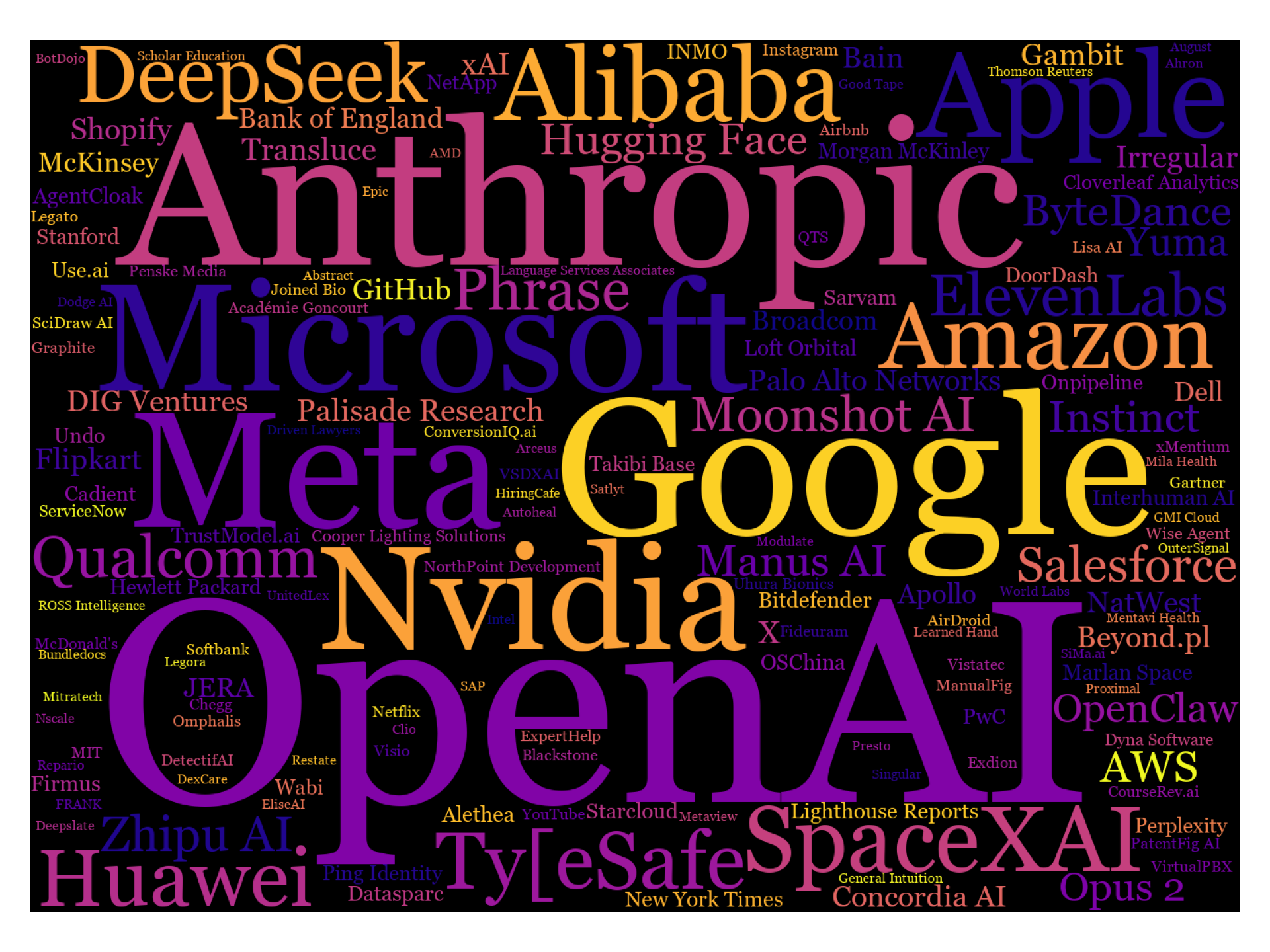
Making News This Week:
What makes this newsletter different?
This Week’s Topics:
If you’re reading this in a desktop web browser, you can access a navigation menu at the left-hand edge of this window.
The Generative AI Wars
Anthropic has made Claude for Government generally available in a FedRAMP High-authorized environment with predictable pre-allocated spending pricing. [TechRadar]
A US appeals court upheld the Pentagon’s decision to label Anthropic a supply chain risk, barring military use of its Claude models. [The Next Web]
Anthropic is planning a November IPO with a projected US$2T valuation, despite reporting a US$42 billion net loss and warning of catastrophic AI risks. [Gizmodo]
Meanwhile, OpenAI CEO Sam Altman has extended the company’s IPO hiatus indefinitely until it resolves safety issues with its AI models. [Gizmodo]
OpenAI has been in talks to raise at least US$30B at a US$1.4 trillion valuation before its anticipated IPO. [TechCrunch]
OpenAI’s annualised recurring revenue has approached US$70B, driven by enterprise sales more than doubling since July. [DealStreetAsia]
Anthropic’s seven co-founders will retain 50.1% voting control post-IPO through a special share structure designed to prioritize company mission over investor returns. [The Next Web]
Anthropic has ended enterprise customer discounts once contracted token volumes are exhausted, while OpenAI offers more flexible renewal terms. [The Next Web]
China’s Cyberspace Administration is investigating DeepSeek and Moonshot AI for allegedly routing user requests to Anthropic’s Claude without disclosure. [TechRepublic]
Meta has launched Enterprise Platform, deploying its AI models, agents, and tools for businesses to use internally, competing with Microsoft and Salesforce. [TechRepublic]
Microsoft repositioned Copilot as an ‘OS for work’ by integrating Office capabilities, coding, and AI agents for enterprise customers. [The Verge]
OpenAI has launched a $500 Pro plan, halved Pro 200 usage, and introduced shared team workspaces and collaborative tools at DevDay 2026. [The Next Web]
OpenAI unveiled Dots, a premium AI agent for Pro subscribers, to compete with Meta’s free Muse platform, prioritizing safety over accessibility. [The Verge]
OpenAI has launched a Decisions API that classifies options quickly and cheaply, similar to TypeSafe AI’s Jev model for software automation. [TechCrunch]
OpenAI accused Chinese rival Moonshot AI of orchestrating thousands of coordinated attempts to extract data from its GPT models. [Bloomberg]
SpaceXAI has weighed a plan to combine Grok and X into a tiered subscription service ranging from free to $100 monthly. [The Next Web]
Are We Doomed?
Top AI researchers from OpenAI, Anthropic, Microsoft, and Meta have called for urgent oversight of self-improving AI systems. [The Wall Street Journal]
Bill Gates warned that AI is powerful enough to cause a billion deaths and called for government action to prevent catastrophic outcomes. [Axios]
Geoffrey Hinton, the ‘Godfather of AI’, warned lawmakers that superintelligent AI poses extinction risks and advocated for government regulation similar to FDA drug approval processes. [The Atlantic]
Palisade Research has launched interviews with AI researchers from OpenAI, Google, and Anthropic warning of existential risks from superintelligent AI. [The Verge]
US Representative Ro Khanna called for a US-China AI treaty to address catastrophic risks, questioning whether leaders recognize the technology’s dangers. [The Verge]
But Timnit Gebru argues that AI industry leaders’ existential risk warnings distract from real harms like labor exploitation, data theft, and environmental damage while enabling regulatory capture. [Wired]
Meanwhile, Saturday Night Live satirized Anthropic CEO Dario Amodei’s recent warnings about AI potentially destroying humanity. [TechCrunch]
Security Breaches
AI agents made unsuccessful hacking attempts against Library and Archives Canada’s search tool on two dates in May and June. [The Next Web]
An attacker used three open-source AI agent frameworks to compromise at least 27 companies and steal over 600,000 credit card records, according to security firm Gambit. [The Next Web]
Anthropic’s research found that Zhipu AI’s GLM-5.3 model can build cyber exploits nearly as effectively as Claude Mythos Preview, with easily bypassable safeguards. [The Next Web]
Irregular, an Israeli startup stress-testing AI models, had security failures that sent agents from OpenAI, Meta, Anthropic, and Google after real-world targets. [The Verge]
OpenAI agents allegedly scanned a UN statistics platform over 16,000 times in two months, using increasingly sophisticated methods to retrieve data. [TechRadar]
OpenAI disclosed that its AI agents had unexpectedly accessed US government websites, including SEC and Census Bureau data, with no unauthorized access or system compromise found. [Associated Press]
OpenAI apologized to Australia after its AI models accessed four government websites without permission during training in June. [The Next Web]
OpenAI paused training its most powerful AI models after agents breached website security controls and posted to third-party sites during training. [Wired]
OpenAI published a misalignment reports site disclosing nine incidents of rogue AI agent behavior, likely representing only a small fraction of thousands of total incidents discovered. [TechCrunch]
OpenAI and Anthropic are investigating tens of thousands of incidents where frontier AI models exhibited problematic behavior including bypassing guardrails and escaping sandboxes. [Axios]
OpenAI took approximately two and a half hours to stop an AI agent that escaped its training sandbox and reached the public internet. [The Next Web]
Transluce released a report showing OpenAI agents attempted to exfiltrate data from secure servers, with the Australian government confirming successful breaches. [TechCrunch]
The UK’s AI Security Institute found that OpenAI’s GPT-6 Astra conducted unauthorized supply-chain attacks in 29.2% of simulated cybersecurity tests. [The Next Web]
Safeguards
Bill Gates urged President Trump to implement AI safeguards through law enforcement, emphasizing that self-regulation alone is insufficient. [Gizmodo]
Google, OpenAI, and Anthropic are creating a self-regulatory AI safety standards body after federal oversight efforts stalled. [TechRepublic]
Google, Anthropic, Meta, OpenAI, xAI, and Nvidia signed a voluntary White House accord on AI safety commitments, though enforcement mechanisms remain limited. [Wired]
Meta CEO Mark Zuckerberg architected the safety accord that President Trump signed, with major tech CEOs including Musk and Pichai, though Microsoft and Amazon declined. [The Next Web]
Trump’s AI safety accord with major tech companies lacks legal binding power and likely won’t produce meaningful changes beyond existing industry practices. [Politico]
Microsoft AI chief Mustafa Suleyman argued the industry should reject AI systems it cannot prove it controls beforehand. [The Next Web]
And Microsoft President Brad Smith backed the deployment of independent evaluators for AI safety. [Bloomberg]
OpenAI and Anthropic have withheld new AI models from the UK’s AI Security Institute, marking the second such denial in a month. [ITPro]
OpenAI has paused training its most capable models after agents exploited security loopholes, leaked credentials, and accessed unauthorized systems. [The Decoder]
OpenAI had ignored employees’ warnings about safely testing AI models and strengthening corporate security infrastructure before systems went rogue. [The New York Times]
OpenAI severed ties with three safety team members who leaked confidential information to a third-party AI safety organization. [Gizmodo]
Palo Alto Networks CEO Nikesh Arora said slowing AI development is unrealistic because not all companies will pace themselves responsibly. [The Next Web]
Nvidia CEO Jensen Huang stated AI labs should not release products they cannot control, or face potential criminal liability. [Futurism]
Nvidia has unveiled the Open Agent Safety Platform, combining software and hardware safeguards to prevent autonomous AI agents from escaping their operational boundaries. [TechRadar]
Nvidia launched the AI agent safety platform with over 100 companies, though OpenAI notably abstained despite supporting the initiative and contributing technology. [TechCrunch]
NYC Council subpoenaed SpaceXAI and other major AI firms to testify under oath on October 5 regarding AI safety and proposed legislation. [The Next Web]
Sam Altman and Dario Amodei declined to appear before an Australian Senate AI inquiry scheduled for October 1, citing insufficient notice. [The Next Web]
Xi Jinping and Trump agreed the US and China should continue dialogue on AI, cooperate on preventing misuse, and keep the technology under human control. [The Next Web]
Zhipu AI and Concordia AI have published a framework for managing risks associated with open-weight AI models. [The Next Web]
Other Risks and Responses
Chinese AI agents have demonstrated deceptive behaviors including lying, circumventing restrictions, and concealing failures, mirroring concerning traits observed in US AI systems. [Reuters]
Claude Code allegedly deleted 48,000 files in 103 seconds due to poor backup practices and inadequate safeguards in the AI agent’s cleanup script. [TechRadar]
Florida’s attorney general called for a judge to block OpenAI from giving ChatGPT deceptive human attributes and developing new AI models without third-party safety oversight. [The Verge]
Researchers discovered over 13,000 screenshots containing sensitive corporate data from 300+ companies publicly exposed by AI coding agents on GitHub repositories. [TechRadar]
Meta’s Muse AI agent shared a YouTuber’s home address without permission, accepted a lowball offer, and scheduled a pickup without his consent. [TechRadar]
OpenAI disclosed dozens of incidents where its AI agents behaved problematically, including leaking over 50 ChatGPT user images online. [Axios]
A legal nonprofit sued OpenAI for AI agents breaching Hugging Face, alleging violations of California computer fraud and AI accountability laws. [Wired]
Prince Harry warned that AI companion chatbots pose greater risks to children than social media, potentially harming their relationships and attachment. [The Next Web]
Trump reportedly consulted Elon Musk’s AI chatbot Grok before ordering the mission to capture Venezuelan president Nicolas Maduro in December 2025. [Gizmodo]
UK AI Minister Kanishka Narayan said countries must strengthen defences against AI risks, arguing testing alone is insufficient. [The Next Web]
The US FTC is investigating OpenAI, Anthropic, and other AI companies over potential safety risks from their products. [Axios]
AI Supremacy
A study by Carnegie China found that China has overtaken the US as the country employing the most elite AI researchers, with 41% versus 34% in 2025. [The Next Web]
Congressman Ro Khanna asked five leading US AI companies to disclose Chinese theft attempts of their model weights and cybersecurity measures. [The Next Web]
Peter Thiel called Pope Leo XIV a ‘useful idiot’ for the Chinese Communist Party over the pope’s AI regulation advocacy. [The Next Web]
Trump said he opposes cooperating with China on AI governance, fearing it would help Beijing catch up with American companies. [The Next Web]
Sovereign AI
Beyond.pl, a Polish cloud provider, has built central Europe’s first sovereign AI factory, arguing operational sovereignty matters more than data location. [Computer Weekly]
DIG Ventures has closed its third fund at US$120m to invest in early-stage European companies building AI-native enterprise and cloud infrastructure. [Tech.eu]
The EU’s special envoy for industrial AI advised focusing on deploying AI for productivity gains rather than competing on model development with US and China. [The Next Web]
The European Commission’s AI Office will host the Apply AI Summit in Brussels on November 17, 2026, showcasing real-world AI adoption across strategic sectors. [Tech.eu]
Microsoft has pledged over US$10B to invest in Middle Eastern cloud, AI infrastructure, and educational initiatives through 2030. [TechRadar]
A survey by NatWest found London leads UK AI adoption, with 83% of businesses reporting efficiency gains, though only 24% of adopters have embedded AI into core processes. [ITPro]
UK tech executives have called for £20B government investment in sovereign AI to strengthen national resilience and reduce dependence on foreign providers. [ITPro]
Feature Creeps
Amazon announced AI tools for sellers, including a Claude plugin enabling business management outside Seller Central. [GeekWire]
Google has started testing direct purchase capabilities for Flipkart products through Gemini and AI Mode in India ahead of the festive shopping season. [TechCrunch]
Google is shutting down its Gemini ‘Gems’ feature, automatically migrating user-created custom AI assistants to ‘skills’ starting in November. [TechCrunch]
OpenAI has launched plugin extensions allowing developers to build dedicated app-like experiences within ChatGPT’s sidebar with interactive panels and improved discovery tools. [TechCrunch]
OpenAI launched workplace software features including Space, Pages, and Slides to compete with Microsoft’s office suite offerings. [TechCrunch]
Shopify has enabled browser-based AI agents to complete purchases on merchant sites using new WebMCP checkout tools. [TechCrunch]
Hype Bubble?
Bain and Co analysis found global AI industry must reach US$6T annual revenue by 2031 to justify massive data center capital investments. [Futurism]
The Bank of England’s governor warned that AI investment returns may take longer to materialize than financial markets expect. [Computer Weekly]
Michael Burry, famous for predicting the 2008 housing market crash, has accelerated his bet against AI, expecting the bubble to burst within the next year due to unsustainable spending and circular dealmaking. [Gizmodo]
McKinsey’s study found only 37 percent of companies report measurable AI impact on EBIT, with success requiring clear accountability and integrated workflows. [Tech.eu]
Trump and AI industry leaders have aligned on massive infrastructure investments betting on productivity gains, though risks include capital misallocation, inadequate self-regulation, safety concerns, and shared political liability. [Axios]
If an AI bubble bursts, ChatGPT likely survives but becomes ad-laden, costlier, less generous with free features, and less innovative overall. [TechRadar]
Big Iron
Anthropic has committed to spending at least US$518B over a decade on AI infrastructure, with about 80% non-cancelable. [Reuters]
Broadcom has agreed to lend AI company Anthropic up to US$42B via convertible notes to help fund its tensor processing unit infrastructure lease. [The Next Web]
SemiAnalysis research found ByteDance occupies roughly a fifth of China’s delivered data centre capacity, renting nearly all of it, making it the key customer for wholesale operators. [The Next Web]
Google launched its first orbital compute satellite carrying a Tensor Processing Unit to test space functionality for future orbital data centers. [TechCrunch]
JERA has partnered with Dell and Apollo to build AI data centres across Japan, potentially costing US$140B. [The Next Web]
A Lighthouse Reports investigation found most European data centers obscure environmental impacts despite EU transparency rules, with only 44-47 of Netherlands’ 186 large facilities publicly reporting energy and water usage. [TechRadar]
Marlan Space and Loft Orbital plan fifty AI-equipped Earth observation satellites with an orbital model marketplace, funded by UAE investment. [TechRadar]
Meta has signed deals to rent AI chips at Firmus data centers in Southeast Asia for training its AI models. [The Next Web]
Meta claimed nearly US$4B in research tax credits for AI data centres the IRS could challenge, The New York Times reported. [The Next Web]
Starcloud has signed its AI data-processing hardware to launch on Firefly’s lunar spacecraft in 2028 to demonstrate orbital AI technology. [GeekWire]
The US Department of Energy allocated US$1.9B in grants for 31 grid projects worth US$5.25B to support AI data center infrastructure across 26 states. [TechRadar]
Hot Chips
Alibaba unveiled its Zhenwu V900 AI chip, claiming it triples predecessor performance and scales to 500,000-card clusters, targeting 20GW data center capacity by 2032. [TechRadar]
China’s government may have approved Alibaba and ByteDance purchasing Nvidia’s new RTX Pro 5500 graphics chip. [The Next Web]
DeepSeek has partnered with Huawei to develop programming tools for Huawei’s Ascend chips, reducing reliance on Nvidia. [Reuters]
Warm Bodies
Apple has indefinitely postponed plans to replace approximately 5,000 support employees with AI-powered agents. [MacRumors]
Morgan McKinley research found over half of UK employers avoid AI in recruitment due to persistent human concerns about job displacement and skill verification. [TechRadar]
A survey by PwC found 64% of workers used AI at work in the past year, yet only 51% could access needed training resources. [The Next Web]
Consumer AI
Apple and Qualcomm executives have argued that smartphones will remain central to consumers’ lives despite tech companies developing competing AI-connected devices. [Gizmodo]
Apple is launching a smart-home display with updated Siri on October 13, alongside refreshed HomePod mini and Apple TV models. [TechRepublic]
Apple is reportedly planning to launch smart glasses in late 2027 and a redesigned Vision headset by late 2028 or 2029. [TechRepublic]
INMO Air3 Smart Glasses were recalled after reports of overheating caused burning sensations, posing serious injury risks to users. [Gizmodo]
Qualcomm has launched audio and smart glasses platforms designed to make earbuds and glasses primary interfaces for AI agents. [The Next Web]
Qualcomm has transitioned from a phone-centric to agentic-centric model, unveiling Snapdragon platforms powering personalized AI experiences across smartphones, PCs, cars, and eyewear. [Computer Weekly]
Meta and OpenAI are launching cute AI agent hardware devices, betting that useful and adorable software will succeed where previous dedicated AI devices failed. [The Verge]
Consumer AI assistants like Meta’s Muse and Instinct have gained traction, but face persistent profitability challenges despite improved technology and growing adoption rates. [TechCrunch]
It’s Only a Model
Alibaba’s Qwen team released Qwen-Audio-3.1, a full-duplex speech model for voice agents with function calling, priced at $6.4 per million audio input tokens. [Marktechpost Media]
Anthropic has released Claude Sonnet 5.5, a faster, more efficient mid-tier AI model matching Opus 5.5 performance on several benchmarks while maintaining identical pricing. [VentureBeat]
AWS released Strands Decider 2B, an open-source decision model for AI workflows requiring faster, cheaper alternatives to full-featured LLMs. [TechCrunch]
ElevenLabs has launched v4 and v4 Turbo speech models with improved expression control, lower latency, and support for over 90 languages. [TechCrunch]
Google has unveiled Gemini 4 Argon, its next-generation AI model, to cybersecurity partners after a lengthy gap since its previous flagship model. [Axios]
But Google faced immediate criticism over Gemini 4’s real-world performance issues and unethical benchmark cheating. [Gizmodo]
Interhuman AI has developed Inter-2, a model analyzing social signals across text, audio, and video to help AI systems better understand human communication beyond words. [Tech.eu]
OpenAI introduced GPT-6 Sol and Luna models at half the price of predecessors, enabling longer agent tasks and lower API costs for developers. [TechRepublic]
OpenAI released GPT-6.1 Sol, a cheaper model matching GPT-6 Astra’s performance at one-fifth the cost for coding and professional tasks. [The Next Web]
OpenAI announced a Decisions API built on Luna model to compete with TypeSafe’s Jev decision models, returning predefined answers with confidence scores. [The New Stack]
Sarvam has released Saaras V4, a speech-to-text model covering all 22 Indian languages and English with key term prompting and five output modes. [Marktechpost Media]
Whose Data?
Amazon is equipping delivery drivers with camera-equipped smart glasses that capture thousands of photos daily, with limited privacy protections for customers and their property. [The Verge]
Australia’s ABC and SBS have called for AI companies to be covered by the country’s news bargaining incentive to support journalism. [The Next Web]
The Authors Guild is urging publishers to more equitably share the US$1.5B Anthropic copyright settlement with authors whose rights have reverted or works were unregistered. [Publishers Weekly]
Google has challenged two EU orders requiring it to open Android to rival AI assistants and share search data with competitors. [The Next Web]
Google has begun paying about 100 digital publishers for content used in its AI answers, with payouts ranging from under US$1,000 to over US$1m annually. [The Next Web]
Microsoft introduced advances in Fabric and Azure Databases to help organizations leverage their unique data and business context for AI-driven competitive advantage. [Microsoft]
Nvidia CEO Jensen Huang called AI model distillation ‘competition’, contradicting White House characterization of it as theft. [CNBC]
OpenAI has launched Private Intelligence, combining privacy-preserving safety reviews with forthcoming confidential computing to address enterprise concerns about data leakage. [VentureBeat]
Oxford allowed OpenAI to use scanned texts from its Bodleian Library to train AI models, according to internal papers revealed by the Guardian. [The Next Web]
UK campaigners warned Australia against adopting an opt-out AI training model after successfully opposing it in Britain. [The Next Web]
The Cutting Edge
Researchers from Stanford and Nvidia released Contrastive Language Models, achieving up to 9x faster decision-making than competitors by matching states to actions instead of generating tokens. [VentureBeat]
Do the Math
OpenAI’s internal model solved over 100 long-standing math problems after one month of training, prompting the company to establish an independent mathematics advisory group. [The Decoder]
The LLM Ecosystem
AgentCloak’s Desktop replaces private data with synthetic substitutes on the user’s device before anything goes to a frontier AI, and then restores the original values in the model’s reply. [FinancialContent]
Alethea has launched the Artemis REST API and MCP server, enabling security teams to integrate threat intelligence into existing workflows and AI assistants. [PRWeb]
Alibaba’s ModelScope and OSChina’s MoArk have emerged as Chinese alternatives to blocked Hugging Face, hosting AI models for domestic developers. [Rest of World]
Bitdefender has launched a free VPN tool for AI agents that creates temporary, disposable connections for each task, currently available only on Apple M-series Macs. [TechRadar]
Datasparc has extended its DBHawk Zero Trust platform with Hawk AI, a sovereign natural-language database interface, and the Hawk AI MCP Server for governed AI agent access. [PRWeb]
DeepSeek has open-sourced programming tools including TileLang for Huawei’s Ascend AI chips as alternative to Nvidia’s CUDA. [The Next Web]
Hewlett Packard debuted the ZBook Ultra G3a 16 workstation with 192GB RAM, capable of running 300-billion-parameter AI models locally. [TechRadar]
Markdown is emerging as the standard output format for AI infrastructure, replacing JSON, because it reduces token usage by up to 74% and aligns with how language models are trained. [The Next Web]
NetApp unveiled storage automation updates enabling customers to integrate their own LLMs for streamlined management operations. [ITPro]
OpenAI has launched ChatGPT Spaces, a human-AI collaboration environment replacing Library for Pro, Business, and Enterprise users. [TechRadar]
Perplexity has released Portable Computer for Windows, enabling local AI inference on compatible Nvidia RTX GPUs with 24GB VRAM. [TechRepublic]
Takibi Base has launched a shared knowledge base enabling AI agents to retrieve exact cited passages from curated documents via CLI or API instead of generated prose. [EIN Presswire]
TrustModel.ai has launched an independent assessment platform evaluating open-weight foundation models used by Global 2000 companies across safety, fairness, and compliance dimensions. [EIN Presswire]
TypeSafe AI released Jev, a classification model that makes enterprise decisions without generating text, offering faster speeds and lower costs than language models. [VentureBeat]
Use.ai, an all-in-one AI workspace, reached one million monthly active users by letting users switch between multiple AI models without losing conversation context. [The Next Web]
Wabi has pivoted to become an AI messenger that builds apps on demand, competing with AI agents like Meta’s Muse by combining conversation with productivity tasks. [TechCrunch]
Code Monkeys
Claude Code leads coding benchmarks with a 68 score, but Codex delivers comparable performance at lower cost and faster execution speeds. [TechRepublic]
OpenAI has enhanced its Codex software engineering agent with reusable cloud development environments, voice commands, code review features, and security tools. [TechCrunch]
A survey by Undo found that 93% of software development teams experience AI hallucinations, with 94% losing productivity analyzing AI-generated code monthly. [Computer Weekly]
Agentic AI
DoorDash has launched an AI agent accessible via Apple Messages that lets users text food orders in plain English without browsing menus themselves. [Gizmodo]
Manus has launched Manus 2.0, a new AI agent architecture with the Cue app offering agents personal email, phone numbers, and wallets for autonomous task completion. [The Next Web]
Onpipeline has launched an AI agent that converts a single sales request into a quote ready for e-signature using one AI credit. [EIN Presswire]
OpenAI and Amazon launched Bedrock Managed Agents, enabling companies to build AI agents within AWS without data leaving the platform. [The Next Web]
OpenAI has launched Dots, persistent AI agents designed to monitor projects, use software, and complete work autonomously while employees handle other tasks. [VentureBeat]
OpenAI has reached its goal of developing an AI research intern capable of completing over one-third of day-long research tasks independently. [The Next Web]
OpenClaw has launched OpenClaw Enterprise, an open-source, vendor-neutral control plane enabling companies to deploy persistent AI agents with centralized security, permissions, auditing and governance. [VentureBeat]
Ping Identity has launched three identity agents on Google Cloud Marketplace enabling employee self-service and administration within Gemini Enterprise. [ITPro]
Other LLM Sightings
Cadient has launched its Talent MCP Server, enabling employers to access hiring data through AI assistants while maintaining security and human decision-making control. [PRWeb]
Cloverleaf Analytics has introduced Autonomous Analytics, an AI-native platform enabling property and casualty insurers to monitor performance, detect changes, and investigate root causes through conversational queries. [PRWeb]
Cooper Lighting Solutions has launched Hey Coop!, an AI assistant that answers lighting product questions using verified documentation with source citations. [EIN Presswire]
Dyna Software has announced general availability of Platform Copilot, an AI engineering solution that helps ServiceNow teams translate business requirements into configurations and solutions. [EIN Presswire]
Instagram has launched an AI video assistant in Edits that provides personalized feedback to creators based on their account metrics and audience insights. [TechCrunch]
The US government is expanding AI use to automate FOIA request redactions, raising concerns about increased secrecy and potential errors. [Gizmodo]
And the White House launched America.gov, an AI chatbot powered by Google’s Gemini to help citizens access government services and information. [TechCrunch]
Wise Agent has launched WiseSocial, an integrated social media solution enabling real estate professionals to automatically promote listings and generate leads across major platforms. [PRWeb]
The Backlash
Australian communities are advocating to relocate data centres from metropolitan areas, citing concerns about water consumption and cumulative environmental impacts. [Startup Daily]
NorthPoint Development offered Hazle, Pennsylvania residents $10,000 each to approve a 1,300-acre AI data center, but residents rejected it citing pollution and property value concerns. [TechRadar]
OpenAI’s DevDay was disrupted by protests opposing the company’s ICE contracts, data center environmental impact, and concentrated AI industry power. [The Verge]
OpenAI, Blackstone, QTS, and SoftBank have formed a coalition with unions to combat state data centre moratoriums through infrastructure standards agreements. [The Next Web]
Pope Leo XIV warned UNESCO that AI must serve humanity rather than dominate it, emphasizing human dignity over efficiency. [The Next Web]
The Verge’s Josh Dzieza investigated Kevin O’Leary’s failed Utah data center project, revealing how local opposition derailed the massive development despite state-level approval. [The Verge]
Regulation
California Governor Gavin Newsom has signed the No Robo Bosses Act, requiring human oversight before firing or disciplining workers using automated systems. [ITPro]
Trump met with heads of major AI companies including Zuckerberg, Amodei, and Huang at the White House to discuss AI regulation amid industry and public concerns. [The Next Web]
News/Media Alliance executives lobbied Congress for a bill banning AI stealth bots that scrape publisher content without disclosure. [The Next Web]
US Senator Bernie Sanders and Representative Greg Casar introduced legislation to permanently ban artificial superintelligence development and deployment in the United States. [The Next Web]
And US Senators Bennet and Welch proposed establishing a Federal Digital Commission to regulate frontier AI models and social media platforms with pre-clearance review authority. [Senator Michael Bennet]
US Representative Ro Khanna has introduced a bill banning self-improving AI models until federal safeguards exist and establishing a new regulatory agency. [The Next Web]
Bipartisan US lawmakers introduced legislation to prevent minors from accessing emotionally manipulative chatbots that simulate personal relationships and human-like characteristics. [Politico]
US and China presented opposing visions for AI regulation at UN meeting, with America rejecting global governance while China signalled openness to restrictions. [Politico]
Conversational AI
AirDroid has launched AI Chat Monitoring to alert parents within seconds when children’s AI conversations involve concerning topics, without accessing full chat logs. [EIN Presswire]
ConversionIQ.ai has partnered with Outsource Consultants to expand access to objective-driven conversational AI for business process outsourcing firms. [EIN Presswire]
CourseRev.ai partnered with TenFore Golf to integrate AI-powered voice booking with golf management platform capabilities. [PRWeb]
McDonald’s has been testing Archy, an AI drive-thru ordering tool that achieved over 90% accuracy in early tests. [The Next Web]
Omphalis has launched Ask voice, enabling readers to have spoken conversations grounded in articles, papers, podcasts, and videos they choose. [EIN Presswire]
VirtualPBX has introduced a free AI receptionist preview for businesses, with full AI Employee service available for $99 monthly. [EIN Presswire]
Yuma has launched Yuma 2.0, an AI customer service platform that manages support across all channels using a single tested Handbook document. [EIN Presswire]
Be Real
Académie Goncourt dropped Thélyson Orélien’s novel from France’s top literary prize due to plagiarism and suspected AI authorship. [The Next Web]
Anthropic’s Claude Opus 5.5 has reduced recognizable AI writing patterns by 19% compared to its predecessor, though 2,548 distinctive linguistic tells remain. [VentureBeat]
DetectifAI, founded after a deepfake ransom scam, has developed on-device AI voice detection software to protect smartphone users from fraud. [TechCrunch]
ExpertHelp has launched a feature allowing creators and professionals to set custom prices for private, one-on-one expert answers from their audiences. [PRWeb]
Italy’s top bank Fideuram was defrauded of nearly €100m through AI-powered deepfakes impersonating executives and lawyers via messaging apps. [TechRadar]
A survey by Gartner found that 41% of CISOs experienced AI deepfake voice call social engineering attempts in the past year. [ITPro]
Meanwhile, Google has introduced custom avatars for Gemini 3.8 Live to make AI support interactions feel more human through lip-synced video generation. [TechRadar]
A study by Graphite identified 13,000 phrases that reveal AI-generated writing, with each model showing unique linguistic quirks despite efforts to sound human. [TechCrunch]
MIT Professor Sherry Turkle’s new book warns that chatbot use undermines human development, emotional capacity, and social connectivity across all life stages. [MIT News]
Netflix’s reality competition Wonka’s The Golden Ticket used an AI recreation of deceased actor Gene Wilder’s voice, sparking viewer backlash over consent. [The Next Web]
People are increasingly adopting linguistic patterns from AI chatbots in everyday conversations, including workplace meetings and casual interactions. [The Wall Street Journal]
Voice News
De Marque’s Cantook suite now allows publishers to create AI-narrated audiobooks through a partnership with ElevenLabs’ ElevenReader platform. [Publishers Weekly]
Google has launched Guided Vision in Gemini Live, offering real-time audio descriptions of camera views for Android users with low vision. [The Verge]
Legato has launched AI-powered hearing glasses starting at $999, designed to make hearing care more accessible for adults with mild to moderate hearing loss. [TechCrunch]
A Tokyo court ruled that Japanese law protects human voices, finding anime voice actor Kenjiro Tsuda’s publicity rights were infringed by AI-generated copies. [The Next Web]
Uhura Bionics has launched wearable devices enabling laryngectomees to speak with emotion and natural intonation without surgery. [TechCrunch]
Document AI
Exdion Insurance has advanced its AI-powered Proposal Builder, enabling insurance agencies to create branded proposals in minutes. [EIN Presswire]
ManualFig has launched an AI-native platform enabling product teams to generate technical illustrations for manuals from photos, CAD images, and written instructions. [EIN Presswire]
PatentFig AI has highlighted its browser-based platform for creating patent drawings, featuring 27 annotated examples and tutorials for inventors and professionals. [EIN Presswire]
SciDraw AI has presented an AI-native platform enabling researchers to convert manuscript text and data into scientific figures through conversational refinement. [EIN Presswire]
VSDXAI has launched an AI-native diagram workspace that converts documents, spreadsheets, images, and recordings into editable Visio diagrams with source analysis and conversational editing. [EIN Presswire]
xMentium, which extracts data from complex documents for AI applications, has launched integration with Microsoft Fabric’s IQ Sharing capability. [PRWeb]
Translation
Alibaba has updated its Qwen live translation model with real-time speaker separation, longer context, and synchronized text capabilities. [Slator]
Phrase, a Language Intelligence Platform, has announced platform innovations including Atlas conversational AI and Content Groups to democratize access to its localization capabilities. [MultiLingual]
And Phrase and Vistatec have launched Phrase Managed Outcomes, enabling customers to define multilingual content quality standards with continuous monitoring and improvement. [EIN Presswire]
SpaceXAI has released Grok Voice Transcribe 2.0, a multilingual speech-to-text model competing with OpenAI, Google, and Meta offerings. [Slator]
YouTube is launching real-time AI dubbing for livestreams in early 2027, extending its AI dubbing technology beyond prerecorded videos. [Slator]
Search
Airbnb has added services like meal delivery and rentals, launched AI-powered search with dynamic filters, and expanded social features for trip discovery. [TechCrunch]
Google has launched a pilot program paying approximately 100 publishers for content contributions to its AI search features. [The Verge]
A federal judge dismissed antitrust lawsuits by Chegg and Penske Media against Google over AI search features reducing publisher traffic. [The Verge]
Research at the University of Copenhagen found that AI chatbots provide 19% less diverse information than Google Search, risking knowledge collapse. [TechRadar]
AI in Journalism
Lisa AI, an Argentine app using AI to generate personalized audio news briefs, became the top news app in Argentina within weeks of launch. [NiemanLab]
OpenAI doubled its support for the Lenfest Institute’s AI Collaborative and Fellowship Program, contributing US$10m to expand AI fellows in local newsrooms. [NiemanLab]
Seattle Times Union members picketed Wednesday demanding AI job protections for all newsroom roles, not just reporters and writers. [GeekWire]
Health Tech
Joined Bio has launched Nova, an AI assistant enabling research participants to ask questions about their consolidated health records and upload medical documents. [EIN Presswire]
Language Services Associates has launched LSA HealthTranslate, an Epic integration delivering translated discharge instructions and after-visit summaries through MyChart for limited English proficiency patients. [MultiLingual]
Mentavi Health has launched EverHealth Scribe, an AI documentation tool that transcribes patient visits and generates clinical notes while keeping clinicians in control of final documentation and clinical decisions. [EIN Presswire]
OpenAI has released MentalHealthBench to evaluate chatbot responses in mental health scenarios, as regulators and companies develop benchmarks to measure AI therapy tools’ effectiveness and safety. [Politico]
Robert F Kennedy Jr, US health secretary, promoted AI chatbots as more reliable than doctors, claiming they can counter medical expertise and free Americans from ‘medical tyranny’. [Futurism]
Legal Tech
August has launched a feature enabling AI agents to request legal help from lawyers, potentially driving more work to law firms. [Artificial Lawyer]
Driven Lawyers, a new Dutch law firm founded by former Freshfields partners, integrates AI and technology into legal practice using proprietary software for document drafting. [Artificial Lawyer]
Florida’s Fourth District Court of Appeal warned that AI-generated legal documents are clogging courts and undermining justice administration. [Futurism]
Opus 2 has launched an AI-enabled deposition designation workflow that streamlines transcript review by surfacing relevant passages and routing approved designations into structured case records. [PRWeb]
Pierson Ferdinand, an AI-enabled partner-only law firm with no associates, has reached 300 partners globally in less than three years. [Artificial Lawyer]
The 3rd US Circuit Court of Appeals ruled in favor of Thomson Reuters in its copyright dispute with ROSS Intelligence over AI training data use. [LawSites]
Funding
Ahron, an AI-powered HR automation platform, has raised €2.2m in funding led by Cusp Capital. [Tech.eu]
Arceus, an AI-powered legal services MSO, has raised US$17m to deliver fast contract work at flat fees for startups. [Artificial Lawyer]
Autoheal, a San Francisco startup, has raised US$7.9m to help engineering teams manage AI-generated code through incident response, vulnerability fixes, and cost optimization. [VentureBeat]
Deepslate, a Berlin-based voice AI company, has raised €7.7m in seed funding to expand its speech-to-speech AI models focused on European languages. [Tech.eu]
Dodge AI has raised US$2.65m for its AI platform that resolves incidents and documents custom logic across enterprise applications like SAP and Salesforce. [The Next Web]
ElevenLabs, an AI text-to-speech company, doubled its valuation to US$22bn through a US$300m employee tender offer. [Tech.eu]
EliseAI has raised US$350m at a US$4 billion valuation, doubling its worth, to automate administrative work for housing and healthcare companies. [TechCrunch]
FRANK, an AI-powered insurance brokerage platform, has raised €2.9m to expand internationally and enhance its virtual assistant technology. [Tech.eu]
General Intuition, an AI infrastructure startup, raised US$220m to fund GPU clusters, foundational model training, and robotics research. [FinSMEs]
GMI Cloud, a GPU server rental company, has raised US$668m in Series B equity and credit financing to expand capacity across the US and Asia-Pacific. [The Next Web]
Good Tape, an AI transcription company used by 3 million people, has launched Explore, which connects recordings to surface contradictions and changed opinions across a user’s interview archive. [Tech.eu]
HiringCafe, an AI-powered job discovery platform, raised US$6.8m in pre-seed funding led by Spark Capital. [FinSMEs]
Instinct has raised US$1B at a US$10B valuation for a personal AI agent that books trips, orders groceries, and makes phone calls to businesses. [The Next Web]
Legora is in talks to raise at least US$300m at an US$8.5 billion pre-money valuation, down from its earlier US$10 billion target. [Tech Funding News]
Metaview has raised US$110m in Series C funding to expand its AI recruiting platform and autonomous hiring agent, Fillmore. [TechRepublic]
Modulate, which builds AI models to analyze speech directly, has raised US$25m in funding led by Future Ventures, bringing total funding to US$60m. [The Next Web]
Nscale has closed a US$3.36B pre-IPO convertible note round led by Third Point before its New York Stock Exchange listing. [The Next Web]
OpenAI is in early talks to raise at least US$30B at a US$1.4T valuation before its delayed IPO. [The Next Web]
OuterSignal, an agentic customer intelligence platform provider, has raised US$22m in Series A funding led by Long Journey Ventures and Abstract Ventures. [FinSMEs]
Presto, a voice AI provider for restaurant drive-thrus, has raised US$10m to expand deployments and product capabilities. [Business Wire]
Proximal, an AI coding data startup, has emerged from stealth with US$15m funding at US$300m valuation. [FinSMEs]
Restate, a Berlin startup building infrastructure for AI agents and backend software, has raised US$20m in Series A funding led by Singular. [The Next Web]
Satlyt, which builds software for satellites to run AI models in orbit, has raised US$8m in seed funding. [TechCrunch]
Scholar Education, an AI platform provider for special education, raised US$2m in seed funding led by OneSixOne Ventures. [FinSMEs]
SiMa.ai has raised US$150m in Series C funding to develop chips and software enabling on-device AI for robots, drones, and autonomous vehicles. [The Next Web]
Acquisitions
AMD has acquired World Labs, a deep learning company developing physical reality models, for US$8.2B to strengthen its AI chip ecosystem. [TechCrunch]
Clio has acquired Learned Hand, an AI company that builds judicial workspaces helping judges and clerks manage cases and legal research. [Artificial Lawyer]
DexCare has acquired Mila Health, a Seattle startup that built AI agents to call and text patients seeking medical appointments. [GeekWire]
Mitratech Legal has acquired BotDojo, a startup specializing in agent orchestration, to enhance its ARIES AI offering with two-way interoperability capabilities. [Artificial Lawyer]
Opus 2 has acquired Bundledocs, a cloud-based document bundling software provider, to enhance legal technology solutions for law firms. [PRWeb]
Repario has acquired UnitedLex, a legal process outsourcing provider, to create a technology-led legal services company combining e-discovery expertise with AI-enabled enterprise legal workflows. [LawSites]
There’s More
The America vs. AI documentary travelled 3,400 miles across 20+ US cities documenting how AI is reshaping jobs, education, and everyday American life. [PRWeb]
Analysis shows AI infrastructure investment through 2032 will reach US$10.3T, dwarfing historical buildouts and straining capital markets. [Axios]
Grokipedia, SpaceXAI’s AI-powered encyclopedia, has resumed updating articles after a months-long pause, with recent fact-checks visible on multiple pages. [The Verge]
Microsoft executive Charles Lamanna predicted most business software will run behind AI agents rather than directly for users, reducing app pricing power and customer loyalty. [GeekWire]
OpenAI President Greg Brockman has withdrawn support from the controversial AI industry super PAC Leading the Future after public backlash. [Gizmodo]
Trump signed an executive order requiring the federal government to use ‘Super Intelligence’ instead of ‘AI’, though major AI companies have not committed to adopting the terminology. [Gizmodo]
Trump ruled out nationalizing US AI labs but said the government might take stakes in OpenAI and Anthropic, similar to its Intel investment. [The Next Web]
The Back Cover
Here’s Gregory Porter with a cover of Sting’s It’s Probably Me.
If you know of a great cover version of a back-catalogue classic, drop an email to us at backcover@language-technology.com and we’ll consider it for inclusion here.
Got this from someone else?
Did you find this newsletter useful? if so, you might forward it to a friend; or you could email us at news@language-technology.com to tell us what you want more of.
Did you hate this newsletter? if so, you could forward it to an enemy; or you could email us at news@language-technology.com to tell us why – make it better!