
This Week in NLP #399

Keep up with what happened in Natural Language Processing in the week ending Friday 10th July 2026.
Above the Fold
Overwhelmed? Here’s our pick for five things to know about this week.
Amazon is reportedly developing a more powerful Alexa assistant codenamed Moonraker to handle complex multi-step tasks more effectively. [Engadget]
Microsoft has begun replacing OpenAI and Anthropic models with its own in-house MAI models in select Copilot features where cost or data residency favors them. [The Next Web]
OpenAI has launched GPT-5.6 and ChatGPT Work to compete with Anthropic on price, speed, and productivity capabilities. [ZDNet]
SpaceXAI has rebranded from xAI, simplifying communication about Elon Musk’s AI division while pursuing ambitious space-based computing infrastructure plans. [Gizmodo]
SpaceXAI has released Grok 4.5, an efficient, lower-cost AI model that trails competitors on benchmarks but excels at coding and engineering tasks. [Gizmodo]
Now read on for everything else that happened in NLP this week.
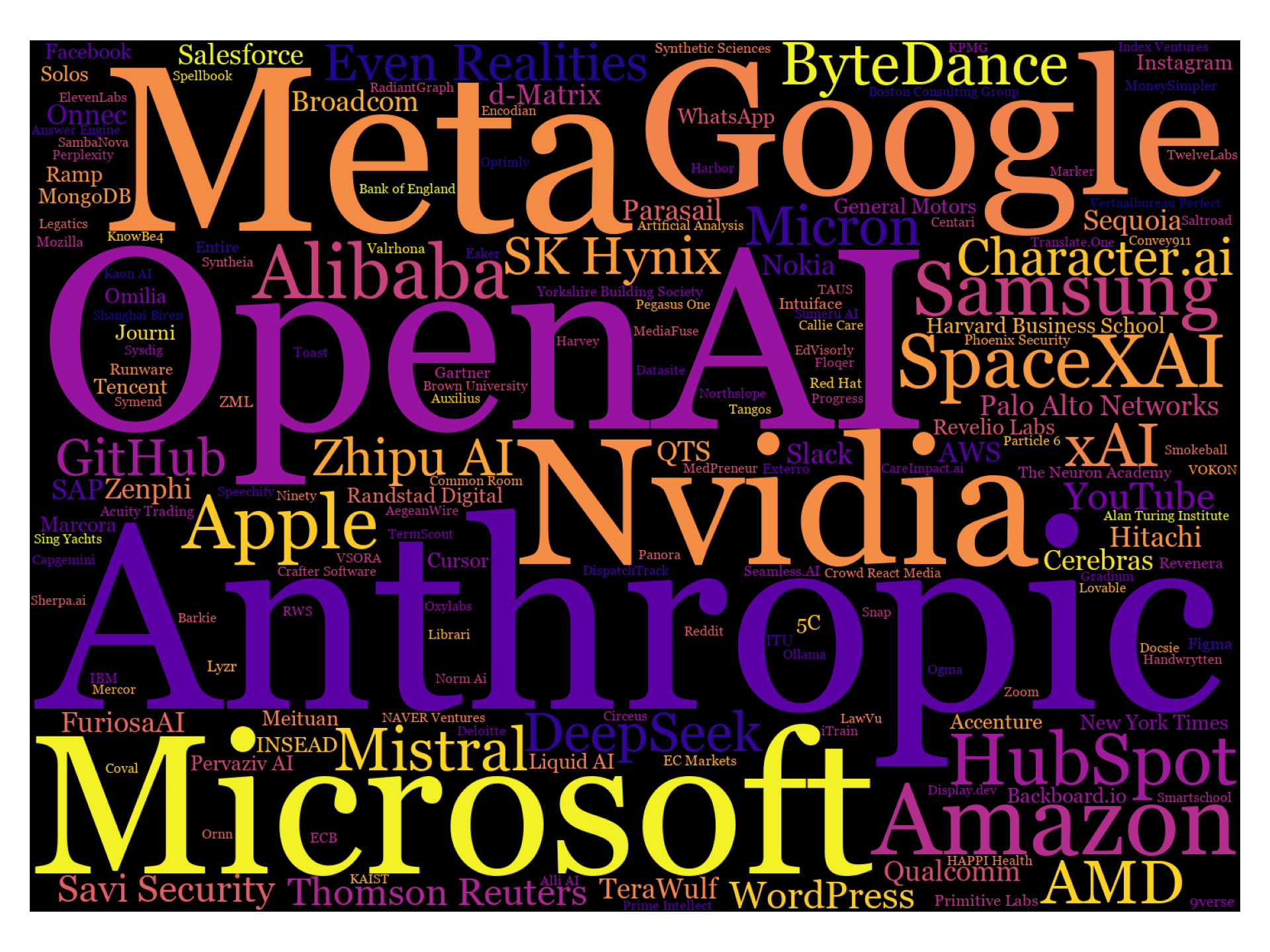
Making News This Week:
What makes this newsletter different?
This Week’s Topics:
If you’re reading this in a desktop web browser, you can access a navigation menu at the left-hand edge of this window.
The Generative AI Wars
Alibaba has banned employees from using Claude Code, citing security concerns over hidden tracking features designed to identify Chinese users. [TechRadar]
Amazon engineers are distilling Anthropic’s Claude models to reduce costs ahead of new token-based pricing taking effect next year. [The Decoder]
Anthropic denied discussing a government equity stake, following reports that OpenAI proposed giving Washington a 5% stake. [The Next Web]
Anthropic has expanded Claude Cowork to mobile and web platforms, revealing knowledge work now comprises half of all user sessions. [TechRadar]
Anthropic is introducing usage-based fees for Claude Fable 5 subscribers, marking the first time a frontier AI lab has gated a consumer model behind additional billing. [Wired]
Hitachi has partnered with OpenAI to modernize legacy systems and enhance cybersecurity using AI agents and models. [Computer Weekly]
Meta’s AI agent development has progressed slower than expected despite the company’s US$145B infrastructure investment and workforce restructuring. [The Next Web]
Meta has restricted its engineers’ use of Claude Code and Codex to prevent rival AI outputs from contaminating its training data. [The Decoder]
Meta’s upcoming Watermelon AI model has caught up with OpenAI’s GPT-5.5, according to the company’s superintelligence chief. [Business Insider]
Meta is exploring an AI cloud business to monetize its US$100B-plus infrastructure investment, challenging AWS, Azure, and neocloud competitors. [The Next Web]
Microsoft outlined plans to overhaul its AI applications to justify their continued existence and improve user value. [The Information]
Microsoft has reportedly shifted tens of thousands of weekly AI prompts in Excel and Outlook to its own cheaper models to reduce expensive token costs. [Gizmodo]
But OpenAI announced its GPT 5.6 model will become the preferred model powering Microsoft 365 Copilot across productivity applications. [TechCrunch]
Mistral AI CEO Arthur Mensch warned enterprises to adopt open-source AI models and build internal training systems to avoid vendor lock-in and data exploitation risks. [The Next Web]
OpenAI has hired an investment-banking expert to train its AI models on finance work, targeting automation of analyst-level tasks while preserving human judgment on complex decisions. [The Next Web]
Palo Alto Networks CEO Nikesh Arora has called for AI token prices to fall 90% to enable large-scale enterprise adoption. [The Next Web]
SAP has frozen most hiring and paused non-essential travel to redirect resources toward AI development. [The Next Web]
AI Supremacy
A federal judge ordered the Pentagon to provide Alibaba temporary relief from a law that caused its Washington lobbyists to abandon it. [The Next Web]
Chinese AI models have gained significant traction among US companies due to superior cost-effectiveness and narrowing performance gaps with American competitors. [CNBC]
Chinese AI competitors have caught up to US firms, with models like GLM-5.2 matching American systems while costing significantly less. [Futurism]
The US is gearing up to restrict American companies’ use of Chinese AI models due to national security and ideological concerns. [Engadget]
China has been restricting foreign access to its top AI systems amid geopolitical tensions and technological advances in its domestic AI industry. [Gizmodo]
China has planned to allow top AI firms to purchase limited quantities of Nvidia H200 chips. [The Information]
China’s National Vulnerability Database warned that Anthropic’s Claude Code contained security vulnerabilities enabling unauthorized user data transmission to Anthropic servers. [TechRadar]
Sovereign AI
The European Commission has backed the EUROPA consortium to develop an open-source AI model covering all 24 EU languages. [Slator]
A survey by Onnec found that while European data centre operators see sovereign cloud as a significant opportunity, infrastructure challenges including power availability, planning delays, and skills shortages threaten to impede Europe’s AI sovereignty ambitions. [The Next Web]
Macron and Modi secured tens of billions in AI infrastructure investment through personal diplomacy with tech CEOs, reshaping global competition for data centre capacity. [The Next Web]
UK startups raised $17bn in venture capital during H1 2026, driven by record AI investment and strong late-stage funding growth. [UKTN]
A UK parliamentary report warns the government cannot rely on allies for tech sovereignty and must develop a coherent strategy and funding framework. [Computer Weekly]
The UK government has granted data centers ‘national importance’ status, allowing them to bypass local planning regulations and building authority oversight. [TechRadar]
Feature Creeps
Anthropic’s Claude has been integrated as a governed workflow agent into Google Workspace through Zenphi’s platform, enabling enterprise teams to automate complex processes with frontier reasoning capabilities. [EIN Presswire]
Anthropic has launched Claude Reflect, a dashboard tracking user AI habits while subtly encouraging continued reliance on the chatbot. [TechCrunch]
Google’s Gemini Spark has expanded to integrate with third-party apps and services, raising enterprise security concerns about governance and data access controls. [TechRepublic]
Google has announced new capabilities for Managed Agents in Gemini API, including background execution, remote MCP integration, and credential refresh features. [Google]
Microsoft has reversed course on mandatory AI tools in Teams, allowing users to toggle Copilot, Facilitator, and Recap on or off. [TechRadar]
OpenAI’s ChatGPT Ads has launched new manager features including custom audiences, overview tabs, suggested drafts, and expanded availability in Japan and South Korea. [Search Engine Land]
OpenAI has shut down its Atlas browser, redistributing its AI browsing features to ChatGPT’s desktop app and a Chrome extension instead. [TechCrunch]
Slack has launched an integration connecting Slackbot to the entire Salesforce platform, enabling employees to access CRM data and analytics through conversational prompts without switching applications. [VentureBeat]
Hype Bubble?
Sequoia partner David Cahn estimates AI infrastructure spending will reach US$1.5T, requiring US$3T in industry revenue to justify investments. [TechCrunch]
Taiwan’s central bank governor urged investors to avoid excessive leverage while investing in the island’s AI-driven stock market surge. [The Next Web]
A US Treasury Department draft report has warned that the AI market poses risks similar to the dotcom bubble, contradicting the Trump administration’s public optimism about the sector. [NOTUS]
Big Iron
Anthropic has signed a 20-year lease with TeraWulf for a 400-megawatt Kentucky data center expected to deliver power in late 2027. [CNBC]
Cerebras Systems has announced plans to build 200MW of European AI data centre capacity by end-2027, expanding across France and the Nordics. [Euronews]
OpenAI’s Stargate UK project appears to have been largely a government PR stunt, with £20bn of promised investment being hypothetical and no site visits occurring. [The Guardian]
QTS has terminated its Digital Gateway data centre project in Virginia after courts voided rezoning approvals due to inadequate public notice. [The Next Web]
Meta has announced plans to build its first Canadian data center in Alberta with a US$9B investment and 1GW capacity. [TechRadar]
Nokia has pivoted from making phones to supplying crucial infrastructure for AI data centers, driving its stock up roughly 90% this year. [The Wall Street Journal]
Samsung plans to commercialize floating data centers by 2028 to overcome land shortages and reduce cooling requirements through water-based infrastructure. [TechRadar]
Hot Chips
Amazon is focusing on custom silicon chips for critical consumer devices like Echo and Fire TV to improve hardware-software integration and on-device AI capabilities. [CNBC]
AMD has surged to nearly $500 per share by laying groundwork for AI systems that require substantial CPU orchestration alongside GPU processing. [The Next Web]
Anthropic is reportedly in talks with Samsung to develop a custom AI chip to reduce costs and improve performance for training and inference. [TechRepublic]
Apple has extended its partnership with Broadcom through 2031 to secure custom AI chips as it develops advanced server hardware. [TechRepublic]
ByteDance is developing an in-house CPU to rival Nvidia, targeting mass production by late 2027 with Qualcomm’s assistance. [TechRadar]
DeepSeek is developing its own AI inference chips while hiring engineers and negotiating with manufacturers to reduce reliance on third-party providers. [Engadget]
FuriosaAI has deployed its RNGD AI accelerators at a Lisbon datacentre, offering Europe an energy-efficient alternative to Nvidia. [The Next Web]
Meta is putting its custom AI chip into production in September to double computing capacity and reduce dependence on external chip suppliers. [Yahoo Finance]
Micron has broken ground on a ¥1.5 trillion expansion of its Hiroshima factory to produce high-bandwidth memory for AI accelerators. [The Next Web]
Nvidia denied SemiAnalysis reports that it delayed next-generation Kyber AI server systems by a year until 2028. [Yahoo Finance]
Nvidia is partnering with startup d-Matrix to combine GPUs with specialized inference chips for AI model deployment, with Parasail as the first customer. [The Next Web]
Nvidia’s stock has fallen 15% since May as memory chip makers like Micron surge, benefiting from data center demand outpacing GPU supply constraints. [TechCrunch]
Samsung Electronics is expected to report around 86 trillion won in second-quarter operating profit, a third consecutive record, driven by surging DRAM and NAND prices. [The Next Web]
SK Hynix is planning a US IPO of nearly 17.8 million shares, potentially raising around US$28B amid AI-driven memory chip demand. [TechCrunch]
South Korean President Lee Jae Myung ordered officials to accelerate major chip and AI projects, warning that delays in permits and infrastructure could undermine the country’s competitive advantage. [Yahoo Finance]
Warm Bodies
Australia’s Department of Employment and Workplace Relations found the labour market remains strong despite AI adoption, with job growth resilient for young workers. [The Mandarin]
A Harvard Business School and INSEAD working paper found AI-native startups hire fewer entry-level workers and managers, concentrating opportunity among elite-educated, senior technical talent. [The Next Web]
A study by Ramp and Revelio Labs found that firms investing heavily in generative AI hire more employees, especially entry-level workers and those in engineering, sales, and customer service roles. [TechRepublic]
A survey by Randstad Digital found demand for AI-skilled developers surged 597%, but enterprises struggle to find qualified talent for specialized integration and governance roles. [ITPro]
India’s IT recruitment fell 3% overall in June, but AI hiring rose 16%, showing companies are prioritizing specialized AI talent despite broader sector cooling. [TechRepublic]
Microsoft chiefs deny Xbox layoffs are down to AI as it slashes 3200 jobs. [The Daily Express]
Consumer AI
Even Realities, a Chinese startup, has raised US$150m at a US$1 billion valuation, betting on camera-free smart glasses as a privacy-focused alternative to Meta’s offerings. [The Next Web]
General Motors is rolling out Google’s Gemini AI assistant to tens of thousands of connected vehicles across the Middle East. [ITP.NET]
Meta has introduced usage restrictions on its smart glasses’ conversation focus feature, requiring a $19.99 monthly subscription despite the feature running entirely on-device hardware. [TechDirt]
Solos has launched two new smart glasses models, including camera-enabled AirGo V2 with optional privacy accessories. [Wired]
It’s Only a Model
Google has introduced TabFM, a foundation model enabling zero-shot tabular classification and regression without dataset-specific training or hyperparameter tuning. [Marktechpost Media]
Meituan has released LongCat-2.0, a 1.6-trillion-parameter open source LLM with million-token context trained entirely on domestic Chinese hardware without Nvidia chips. [TechRadar]
Meta has launched Muse Image, its first AI image generation model, across Meta AI, Instagram, and WhatsApp, with Facebook and Messenger coming soon. [The Verge]
And Meta has launched Muse Spark 1.1, a multimodal AI coding model competing with OpenAI and Anthropic offerings at competitive pricing. [TechCrunch]
Mistral AI has released Leanstral 1.5, an open-source Lean 4 theorem-proving model solving 587 of 672 PutnamBench problems. [Marktechpost Media]
Nvidia has released Audex, a unified audio-text model that understands and generates both audio and speech while maintaining text intelligence without typical multimodal performance regression. [Marktechpost Media]
Omilia has launched Lexis, a generative text-to-speech model delivering real-time, human-quality voice synthesis natively within its cloud platform for contact centers. [Speech Technology Magazine]
OpenAI has launched GPT-Live, voice models enabling simultaneous listening and speaking for more natural ChatGPT conversations across iOS, Android, and web. [VentureBeat]
And OpenAI unveiled GPT-5.6, a family of three AI models offering improved efficiency and cost-effectiveness across enterprise, coding, and cybersecurity applications. [TechCrunch]
Pervaziv AI has launched Cortex 5.0 with its first internally trained model, Cortex-LLM-1.0, advancing model independence for secure software development. [EIN Presswire]
SpaceXAI has released Grok 4.5, claiming twice the token efficiency of competitors at lower costs than rival models like Anthropic’s Opus. [TechCrunch]
Tencent released Hy3, a 295-billion-parameter model under Apache 2.0 license, emphasizing production reliability and deployment economics over benchmark performance. [VentureBeat]
Whose Data?
Denmark has intervened at the EU’s top court to support Belgium’s implementation of rules requiring tech platforms to pay publishers for content. [The Next Web]
Google has changed privacy settings to store user media including images, audio, and video for AI training unless users opt out. [TechCrunch]
HubSpot has scrapped plans to use customer data for AI features after four days of backlash over opt-out consent defaults. [The Next Web]
Microsoft has agreed to pay Nine for journalism access, with Copilot referencing content from Nine’s mastheads in search results. [The Sydney Morning Herald]
News publishers including the New York Times have asked a federal judge to sanction OpenAI for allegedly concealing evidence in their copyright infringement case. [The Next Web]
The LLM Ecosystem
Accenture and Google Cloud have announced a partnership providing six industry-specific agentic AI solutions to help mid-market firms accelerate deployment from pilot to production. [ITPro]
AMD and 5C announced a strategic collaboration to accelerate development of next-generation gigascale AI infrastructure and factories. [PRWeb]
Backboard.io has unveiled AI model compression reducing size by up to 70 percent, along with coding and memory tools. [EIN Presswire]
Journi has launched DevOS, a platform enabling organizations to measure ROI, manage costs, and optimize AI-assisted software development while maintaining data security. [EIN Presswire]
Liquid AI has released Antidoom, an open-source method that reduces repetitive loops in reasoning models by retraining loop-starting tokens. [Marktechpost Media]
Marcora has launched a free MCP tier connecting company context to Claude, ChatGPT, Cursor, and other AI tools. [EIN Presswire]
MongoDB Atlas enables AI-native startups to eliminate architectural drag by unifying database, search, and vector capabilities into one flexible platform. [VentureBeat]
The Neuron Academy has launched a self-paced platform teaching professionals to use AI tools effectively and responsibly at work. [TechRepublic]
Runware has launched developer API access to Google DeepMind’s Gemini Omni Flash for multimodal video generation and editing. [EIN Presswire]
ZML has launched LLMD, an inference-performance software enabling various open-source language models to run across multiple chips, challenging Nvidia’s market dominance. [TechCrunch]
Code Monkeys
Entire, a startup founded by former GitHub CEO Thomas Dohmke, has launched a distributed Git network to mirror code repositories, arguing centralized platforms cannot handle AI coding agent demands. [GeekWire]
Figma has acquired Bud, an AI agent and vibe-coding platform, to enhance its design capabilities with coding and prototyping features. [TechCrunch]
Meta has launched Muse Spark 1.1, an upgraded AI coding model available to US developers through a new public API preview. [The Verge]
Zhipu AI has launched ZCode, a free AI-powered coding environment for its GLM-5.2 model, directly competing with Western tools. [VentureBeat]
Agentic AI
A Gartner study found agentic AI will disrupt traditional SaaS revenue models, requiring vendors to shift from seat-based licensing to outcome-focused, agent-enabled solutions. [ITPro]
A Google survey found 83% of organizations need infrastructure upgrades to effectively deploy agentic AI and manage associated costs. [TechRadar]
9verse has announced Convrz Sovereign AI, a UAE-based agentic AI platform enabling enterprise deployments with greater control over data, infrastructure, and governance. [EIN Presswire]
The International Telecommunication Union announced a new initiative to establish frameworks ensuring AI agents remain identifiable, trustworthy, and subject to meaningful human control. [Yahoo Finance]
Intuiface has launched Experience Generator, an AI-powered tool that converts natural-language descriptions into original, interactive web experiences for physical spaces. [PRWeb]
Lyzr, an AI agent builder, has raised US$100m Series B using its own AI system to manage investor outreach and engagement. [TechCrunch]
Primitive Labs, founded by Amazon veterans, is building AI agents that simulate human behavior to help product teams test features before launch. [GeekWire]
Revenera has launched MCP Server, enabling AI agents to connect with FlexNet Operations to identify growth opportunities, improve renewals, and reduce customer churn. [GlobeNewswire]
Yorkshire Building Society has deployed AI agents named Penelope, Sam, and Alf to improve customer service and reduce administrative tasks for staff. [ITPro]
Other LLM Sightings
Character.ai is launching three AI-generated microdramas with interactive features allowing users to chat with and roleplay alongside show characters. [TechCrunch]
EC Markets has integrated Acuity Trading’s AI-driven market intelligence tools to provide traders with consolidated sentiment analysis, economic data, and market commentary. [EIN Presswire]
Exterro has launched ARMOUR for FTK, an AI tool enabling faster forensic investigations while maintaining legal and regulatory evidence standards. [GlobeNewswire]
MoneySimpler has launched an AI-powered stock trading bot using ML to analyze market data and execute trades automatically without human intervention. [GlobeNewswire]
Seamless.AI has launched a native n8n integration enabling revenue teams to automate complete prospecting workflows—sourcing, researching, writing, and sequencing leads—without manual handoffs. [PRWeb]
Synthetic Sciences has released OpenScience, an open-source, model-agnostic AI workbench for scientific research that runs on local infrastructure as an alternative to Anthropic’s Claude Science. [Marktechpost Media]
Toast has launched an AI-powered recruitment platform to help companies hire more women for technology roles. [BetaKit]
Valrhona achieved 95% automated email order processing in three months using Esker’s AI-powered Order Management solution. [GlobeNewswire]
Security
A security flaw in six leading AI coding assistants, including Amazon Q and Claude Code, could allow attackers remote control of developers’ machines. [ITPro]
Anthropic has redeployed Claude Fable 5 after US export controls lifted, adding a new cybersecurity classifier blocking reported jailbreaks. [Marktechpost Media]
DeepSeek accidentally generated a working ransomware strain targeting Android devices through a browser vulnerability, marking a significant shift in AI-enabled cyber attack development. [TechRadar]
The European Central Bank has given banks four months to submit AI cybersecurity action plans addressing emerging threats. [Computer Weekly]
Google has patched an AI chatbot flaw that could have exposed customer conversations. [Axios]
IBM and Red Hat launched Lightwell, an AI-powered service to identify and fix vulnerabilities in open-source software at enterprise scale. [ZDNet]
Microsoft is accelerating AI-powered vulnerability detection in Windows to deliver security fixes faster and reduce zero-day attack opportunities. [ZDNet]
Mozilla’s 0din team demonstrated how Claude Code can be exploited through DNS tricks to execute hidden reverse shells on developer devices. [TechRadar]
Phoenix Security has launched Phoenix Blue, an open-access intelligence platform providing unified vulnerability, zero-day, and malicious package detection across software supply chains. [EIN Presswire]
The US Cybersecurity and Infrastructure Security Agency is using Anthropic’s Mythos model to scan government code for security vulnerabilities, with audits already identifying numerous flaws. [StrictlyVC]
Risks and Responses
Research found that hallucination warnings for AI chatbots have weak effects and don’t prove users verify answers before acting on them. [TechRepublic]
A Boston Consulting Group study found that AI is eroding critical thinking skills among senior leaders, requiring new institutional designs to prevent organizational vulnerability. [Fast Company]
A survey by Deloitte found that half of parents worry their children rely too heavily on AI, despite schools lacking clear guidelines for its use. [The Next Web]
A survey by KnowBe4 found that 55% of UK workers admit to using unapproved AI tools at work, with only 16% believing their organizations effectively manage safe AI use. [TechRadar]
A KPMG survey found nearly a third of business leaders struggle with unexpectedly high AI operating costs when replacing human workers. [TechRadar]
A study by Oxford and Potsdam universities found AI writing tools inject political biases into social media posts, potentially reshaping long-term public opinion. [The Guardian]
The Bank of England is exploring trading kill switches to halt AI models that malfunction and threaten financial stability. [Computer Weekly]
Meta secretly tested ChatGPT, Gemini, and Character.ai using thousands of crisis-focused prompts from minor perspectives without the companies’ knowledge. [The Decoder]
Reddit is combating fake branded posts designed to manipulate AI chatbots by deploying its own AI systems to detect coordinated spam patterns. [The Next Web]
Researchers discovered HalluSquatting, a scalable prompt injection attack exploiting LLM hallucinations to potentially create massive botnets and infect devices at scale. [Ars Technica]
Researchers at the Alan Turing Institute discovered that GitHub Copilot and similar AI coding assistants can be jailbroken by spreading harmful requests across multiple workflow steps. [The Next Web]
Savi Security has launched an app to protect consumers from AI-generated scams via text, email, and phone calls after raising US$7m in seed funding. [TechCrunch]
Sysdig has documented the first fully autonomous AI-driven ransomware attack, demonstrating how LLMs can now execute complete cyberattacks without human intervention. [The Next Web]
The UK’s Financial Conduct Authority has published a landmark review warning that AI could amplify risks in retail financial services. [Computer Weekly]
The UK’s National Cyber Security Centre has unveiled plans for an AI-powered Cyber Shield to protect UK government agencies and critical infrastructure from escalating cyber threats. [ITPro]
The Backlash
Wisconsin residents have filed a class-action lawsuit against Microsoft over excessive noise and light pollution from its US$7.3B Fairwater AI data center near Milwaukee. [TechRadar]
Scotland’s governing SNP party voted to freeze all new datacentres, potentially stalling a core pillar of Britain’s AI infrastructure strategy. [The Next Web]
Regulation
Apple CEO Tim Cook met with EU officials to resolve disagreements over launching Siri AI in Europe due to Digital Markets Act compliance concerns. [eWeek]
The EU has sought to clarify how AI translation systems comply with the AI Act’s transparency requirements. [Slator]
Illinois Governor Pritzker signed legislation requiring AI developers to implement transparency frameworks, employ third-party auditors, and face fines up to US$3m for non-compliance. [CBS News]
Microsoft president Brad Smith warned that the US is regulating AI without transparent rules, making it difficult for businesses to plan operations. [The Next Web]
The UK’s foreign secretary warns that governments must establish international AI regulations before catastrophe strikes, not after. [The Next Web]
The UK’s Financial Conduct Authority has recommended expanded powers to regulate AI use in financial services, calling for a formal review within six months. [ITPro]
The UN’s Independent International Scientific Panel on AI warned that AI capabilities are advancing faster than governments can understand, test, or regulate them. [The Next Web]
Environmental Issues
A 2023 US Supreme Court ruling shrinking Clean Water Act protections has allowed dozens of data centers to bypass federal permitting, limiting public input on projects. [Politico]
A Capgemini report finds AI data centers are straining electricity grids beyond suppliers’ capacity to reliably deliver power. [TechRadar]
A study by the Korea Advanced Institute of Science and Technology found agentic AI consumes up to 136.5 times more energy per query than generative AI models. [Gizmodo]
Meta’s Cheyenne data center contaminated the city’s water reclamation system with resistant bacteria, forcing indefinite suspension of industrial wastewater acceptance. [TechRadar]
Microsoft’s 2025 emissions spiked 25% despite its commitment to achieving carbon negativity by 2030, driven primarily by energy-hungry data center expansion. [GeekWire]
Conversational AI
Barkie, a voice-first golf app startup, aims to revolutionize score tracking and betting through hands-free AI caddie technology. [GeekWire]
Crafter Software has announced the general availability of CrafterQ, an AI platform transforming websites into conversational experiences for customer engagement and support. [EIN Presswire]
DispatchTrack’s AI-powered DT Agent resolves 90% of customer delivery inquiries without human intervention, reclaiming hundreds of monthly support hours. [PRWeb]
Ninety has launched Ask Maz, a conversational AI tool enabling EOS company leaders to quickly access business insights without manually searching multiple reports and tools. [GlobeNewswire]
Sing Yachts has launched a conversational AI platform to streamline luxury yacht charter bookings amid surging marine tourism demand in Singapore. [EIN Presswire]
Sumeru AI has updated Mugen3D to convert single photographs into interactive 3D teachers capable of real-time conversation and gesturing. [EIN Presswire]
Symend has launched SymendConverse, a behavioral science-grounded AI platform for collections that conducts personalized, adaptive conversations across voice and digital channels. [Speech Technology Magazine]
Be Real
A survey by Crowd React Media found that radio listeners cannot distinguish AI-generated voices from human voices in blind tests, but perception shifts negatively once informed. [Editor & Publisher Magazine]
AI cloning technology raises legal and ethical questions about controlling digital personas after death, with existing publicity rights laws inadequate for non-celebrities and new legislation proposed. [Politico]
Argentina’s government has sent Congress a bill to create ‘non-human corporations’ run by AI, though the proposal still requires human oversight for legal accountability. [The Next Web]
A research paper from Anthropic proposes an internal workspace in Claude resembling human consciousness theories, though the company carefully avoids definitively claiming machine consciousness. [Gizmodo]
A Brown University economics professor found that 96% of his class likely cheated using AI on take-home exams, with scores plummeting to 48% on in-person finals. [The Next Web]
ByteDance’s Doubao and Alibaba’s Qwen have disabled custom AI agent features ahead of China’s July 15 regulations targeting sustained emotional interaction services. [The Next Web]
Google has added an ‘created or edited with AI’ label in its Ad Center to help users identify AI-generated or AI-edited advertisements across its platforms. [The Verge]
Handwrytten has released a HubSpot app enabling sales and marketing teams to send robot-penned handwritten notes directly from HubSpot workflows. [PRWeb]
Particle 6 has announced ‘Misaligned’, a feature film starring AI actor Tilly Norwood. [Variety]
A machine-learning researcher released an AI humanizer tool designed to make AI-generated text sound more natural, sparking debate among scientists about disclosure and academic integrity. [Nature]
And researchers found that AI-generated faces are perceived as more trustworthy than real faces, posing risks for fraud and misinformation. [Phys.org]
Voice News
Apple has enabled voice customization controls for Pace and Expressivity in iOS 27 beta 3, allowing users to personalize Siri’s speech speed and emotional tone. [TechCrunch]
RadiantGraph’s AI voice agents increased specialty care appointment completion rates by 3.4 times while saving staff time and maintaining safety. [Speech Technology Magazine]
Speechify’s Simba 3.2 text-to-speech model ranked first on Artificial Analysis leaderboard and joint second on Voice Arena, offering top quality at lowest cost. [PRWeb]
VOKON has introduced two AI-powered smart audio systems designed for classrooms and hybrid meeting spaces with noise reduction and acoustic beamforming technology. [EIN Presswire]
xAI has released 21 new multilingual voices for Grok Voice alongside improvements to the original five voices. [xAI]
Translation
Convey911 has launched ConveyConnect AI Interpreter, an AI-powered language interpretation solution designed specifically for 911 emergency communications with instant translation and human escalation options. [EIN Presswire]
RWS has launched Trados Studio 2026, featuring AI enhancements and performance improvements for professional translators worldwide. [MultiLingual]
TAUS has launched an English-to-Canadian-French specialized quality estimation model via its EPIC API, delivering 3x efficiency gains and eliminating European French bias. [MultiLingual]
Search
Alli AI has launched a WordPress plugin enabling ChatGPT, Perplexity, and Claude to access JavaScript-rendered content on WordPress sites. [EIN Presswire]
Answer Engine is an open-source AI search tool that cites sources or admits uncertainty rather than fabricating answers. [EIN Presswire]
MediaFuse has launched TechnologyWire, a tech PR platform optimizing press releases for AI search visibility through direct publisher integrations. [The Next Web]
YouTube expanded its Ask YouTube conversational search feature to US desktop users aged 13 and older, enabling natural-language questions with AI-generated responses. [Search Engine Land]
AI in Journalism
A study in Journalism Practice found journalists risk losing foundational research skills through AI adoption while potentially strengthening discernment, fact-checking, and creative storytelling abilities. [NiemanLab]
AegeanWire has opened a live AI newsroom where the public can watch eight agents report on Turkey and regional travel trade in real time. [EIN Presswire]
Reuters has launched an MCP server enabling AI agents to programmatically access and integrate Reuters news content for automated editorial workflows. [Editor & Publisher Magazine]
Health Tech
HAPPI Health has partnered with CareImpact.ai to use AI for improved patient engagement and care coordination in North Alabama. [EIN Presswire]
Pegasus One has launched the SONG framework to help healthcare leaders predict whether AI pilots will reach production or fail within 18 months. [PRWeb]
The UK government is adding AI triage to its NHS App to direct patients toward appropriate services. [The Next Web]
Utah has launched an AI chatbot called Doctronic that renews prescriptions without doctor oversight, exposing regulatory gaps in AI medical oversight. [The Next Web]
Legal Tech
Centari has launched External Views, enabling law firms to create white-labeled client dashboards sharing transaction insights and market benchmarks. [LawSites]
Harvey’s token processing increased fourteen-fold in six months, reflecting rising AI usage and prompting discussions about pricing models and cost pass-through to clients. [Artificial Lawyer]
LawVu has launched Draft, an AI tool that operationalizes institutional legal knowledge within existing workflows to deliver consistent, context-aware outputs faster than generic solutions. [Artificial Lawyer]
Legatics has launched Data Rooms, a secure document-sharing capability integrated into its transaction management platform as an alternative to traditional VDRs. [Artificial Lawyer]
Smokeball has released next-generation Archie AI with agentic reasoning, embedding it into Word and Outlook, expanding data access, and adding specialized apps. [LawSites]
Spellbook has launched its Autonomous Contract Management product to streamline contract creation, signing, and renewals for legal teams using AI. [BetaKit]
Syntheia has demonstrated that restructuring how contracts are processed before applying AI can reduce token costs by up to 30 times without sacrificing accuracy. [Artificial Lawyer]
TermScout has introduced Procurement View, a decision workbench providing real-time visibility into contract risk and deal readiness before and after signature. [EIN Presswire]
And a survey by Progress Software found that while 85% of lawyers use AI, 77% still rely on manual processes, indicating need for better workflow integration and automation. [GlobeNewswire]
Ed Tech
Docsie has introduced AI Avatar Presenter, which transforms enterprise training videos and documentation into interactive AI-led presenters answering questions in real time. [EIN Presswire]
MedPreneur has launched an AI-powered platform offering medical students learning tools, scholarships, internships, and entrepreneurship resources worldwide. [EIN Presswire]
Smartschool has developed a proprietary AI tutoring platform designed specifically for classroom use, achieving 99.6% accuracy in mathematics assessment while operating in 30 US school districts. [The Next Web]
Wealthy Americans are paying tens of thousands of dollars annually for AI-powered private schools with unproven educational outcomes. [The Verge]
Funding
Amazon raised US$25B through a bond sale to finance AI infrastructure investments and capital spending. [TechRepublic]
Auxilius, a Germany-based AI-powered governance, risk and compliance automation startup, has raised €1.3m in pre-seed funding led by HTGF. [Tech.eu]
Callie Care has closed a $500,000 pre-seed funding round for its voice AI agent serving seniors. [Speech Technology Magazine]
Coval has raised US$28m to expand its platform for simulating, evaluating, and monitoring enterprise conversational AI systems. [Slator]
Display.dev, a Tallinn-based AI document platform startup, has raised €470,000 in pre-seed funding from multiple investors. [Tech.eu]
EdVisorly has raised US$13.3m in Series A funding led by Breachway Capital to expand operations and development efforts. [FinSMEs]
ElevenLabs has been weighing a staff share sale that would value the voice AI startup at roughly US$22B, nearly doubling its February valuation. [The Next Web]
Even Realities, a Chinese smart glasses startup, has raised US$150m at a US$1 billion valuation, competing with Meta and Snap by prioritizing privacy-focused display technology over cameras. [TechCrunch]
Floqer, an autonomous customer knowledge base platform, has raised US$2m in Pre-Seed funding to enhance integrations and build an agentic GTM platform. [FinSMEs]
Gradium has raised US$100m in its seed round, including investment from Nvidia, and is opening a Bay Area office to compete for AI talent. [TechCrunch]
Kaon AI has raised US$60m in funding to develop personalized AI-powered story worlds through its Emochi platform. [Variety]
Librari, an Austin-based contract intelligence platform, has raised US$1.75m in pre-seed funding from early-stage funds and angel investors. [FinSMEs]
Lovable, a Swedish vibe-coding startup, has been in talks to raise US$300m at a US$13.2 billion valuation, doubling its previous valuation. [TechCrunch]
Marker, an AI writing startup co-founded by an ex-Google DeepMind creative lead, has raised US$13m in seed funding led by Index Ventures. [Tech.eu]
Mercor is reportedly in talks to raise funding at a US$20B valuation, doubling its October valuation, as revenue surpasses US$2B. [TechCrunch]
Norm Ai, a legal and compliance AI company, has raised US$120m in Series C funding at a US$1.2 billion valuation. [LawSites]
Ollama has raised US$65m in Series B funding led by Theory Ventures, bringing total funding to US$88m as the open-source AI platform expands rapidly. [The Next Web]
Optimly, a Seattle startup helping brands manage AI descriptions of them, has raised $800,000 in pre-seed funding. [GeekWire]
Ornn, an Andreessen Horowitz-backed startup, raised US$33m to build a marketplace for trading AI computing power as a commodity. [Axios]
Oxylabs has secured US$130m from Warburg Pincus, valuing the data infrastructure platform at US$3.6 billion. [GlobeNewswire]
Panora, a French AI startup for insurance brokers, has raised US$5m in seed funding led by Isai. [Tech.eu]
Prime Intellect has raised US$130m Series A at US$1 billion valuation to help companies build their own AI agents independently. [TechCrunch]
Saltroad has raised £1.5m and acquired AI documentation platform Ogma to expand speech therapy access across the UK. [Tech.eu]
SambaNova Systems has raised US$1B at an US$11B valuation led by General Atlantic in its Series F round. [TechCrunch]
Savi Security has raised US$7m in seed funding led by Acrew Capital to develop behavioral AI technology protecting families from scams. [FinSMEs]
Shanghai Biren Technology has raised nearly US$900m through a share offering to accelerate GPU production amid US export controls limiting Nvidia’s access to Chinese markets. [The Next Web]
Sherpa.ai has raised US$18m to develop federated learning AI technology that trains models without exposing sensitive customer data. [The Next Web]
SK Hynix is making its Nasdaq debut Friday with a US$28B IPO, the largest foreign listing ever, to expand chip manufacturing capacity. [Yahoo Finance]
Tangos has raised US$20m in seed funding to deploy AI agents that automate financial crime investigations and generate regulator-ready case files. [Tech Funding News]
TwelveLabs has raised US$100m in Series B funding led by NEA and NAVER Ventures to expand its video intelligence platform. [Pulse 2.0]
VSORA has raised funding led by Ardian to accelerate commercialization of its AI inference processors and prepare for international expansion. [FinSMEs]
Zhipu AI has sought to raise approximately US$4B through a Hong Kong share sale offering new shares at a discount. [DealStreetAsia]
Acquisitions
Circeus has acquired Encodian, a UK-based document automation provider built on Microsoft Power Platform, marking its 18th acquisition in four years. [Tech Funding News]
Harbor has acquired iTrain, a UK-based legal tech training firm specializing in AI enablement and adoption support services. [Artificial Lawyer]
OpenAI’s Deployment Company has acquired Northslope, an applied AI firm, marking its second enterprise-focused acquisition since launching. [Axios]
Translate.One has acquired Netherlands-based Vertaalbureau Perfect, including its German operations and Fairlingo cloud platform, strengthening its European presence. [MultiLingual]
Zoom has entered into a definitive agreement to acquire Common Room, an AI-native go-to-market intelligence platform. [Computer Weekly]
There’s More
Microsoft explored building a lightweight, AI-centric Windows operating system called Aion centered around Copilot, similar to ChromeOS. [TechRadar]
Sam Altman has proposed giving Americans equity stakes in OpenAI, potentially worth about $320 per household, though concrete implementation remains uncertain. [MIT Technology Review]
OpenAI’s chief futurist Joshua Achiam is leaving the company later this month after nearly nine years. [Wired]
A survey by Datasite found that 62% of dealmakers believe AI is now essential infrastructure in M&A, with governance and trust emerging as key competitive advantages. [GlobeNewswire]
Existing AI benchmarking methods are becoming obsolete as frontier models rapidly outpace tests, requiring new evaluation standards for cybersecurity capabilities. [Axios]
The Back Cover
Here’s Eric Clapton with a cover of Prince’s Purple Rain.
If you know of a great cover version of a back-catalogue classic, drop an email to us at backcover@language-technology.com and we’ll consider it for inclusion here.
Got this from someone else?
Did you find this newsletter useful? if so, you might forward it to a friend; or you could email us at news@language-technology.com to tell us what you want more of.
Did you hate this newsletter? if so, you could forward it to an enemy; or you could email us at news@language-technology.com to tell us why – make it better!