
This Week in NLP #403
Keep up with what happened in Natural Language Processing in the week ending Friday 7th August 2026.

Above the Fold
Overwhelmed? Here’s our pick for five things to know about this week.
Google announced major leadership changes at DeepMind amid delayed models, researcher departures, and competitive pressure from OpenAI and Anthropic. [Axios]
Anthropic is building a custom chip team to design hardware that runs its Claude AI models faster and more efficiently. [TechCrunch]
Microsoft disclosed that OpenAI accounts for roughly 70% of its AI business revenue, highlighting its dependence on the partnership. [The Next Web]
Mistral AI has capitalized on US regulatory restrictions and safety concerns to gain market share with open-source models, raising valuations to US$23B. [Wired]
Chinese open-source AI models have created a ‘death zone’ for mid-tier US competitors, who cannot match free Chinese alternatives or command premium prices like frontier leaders. [The Next Web]
Now read on for everything else that happened in NLP this week.
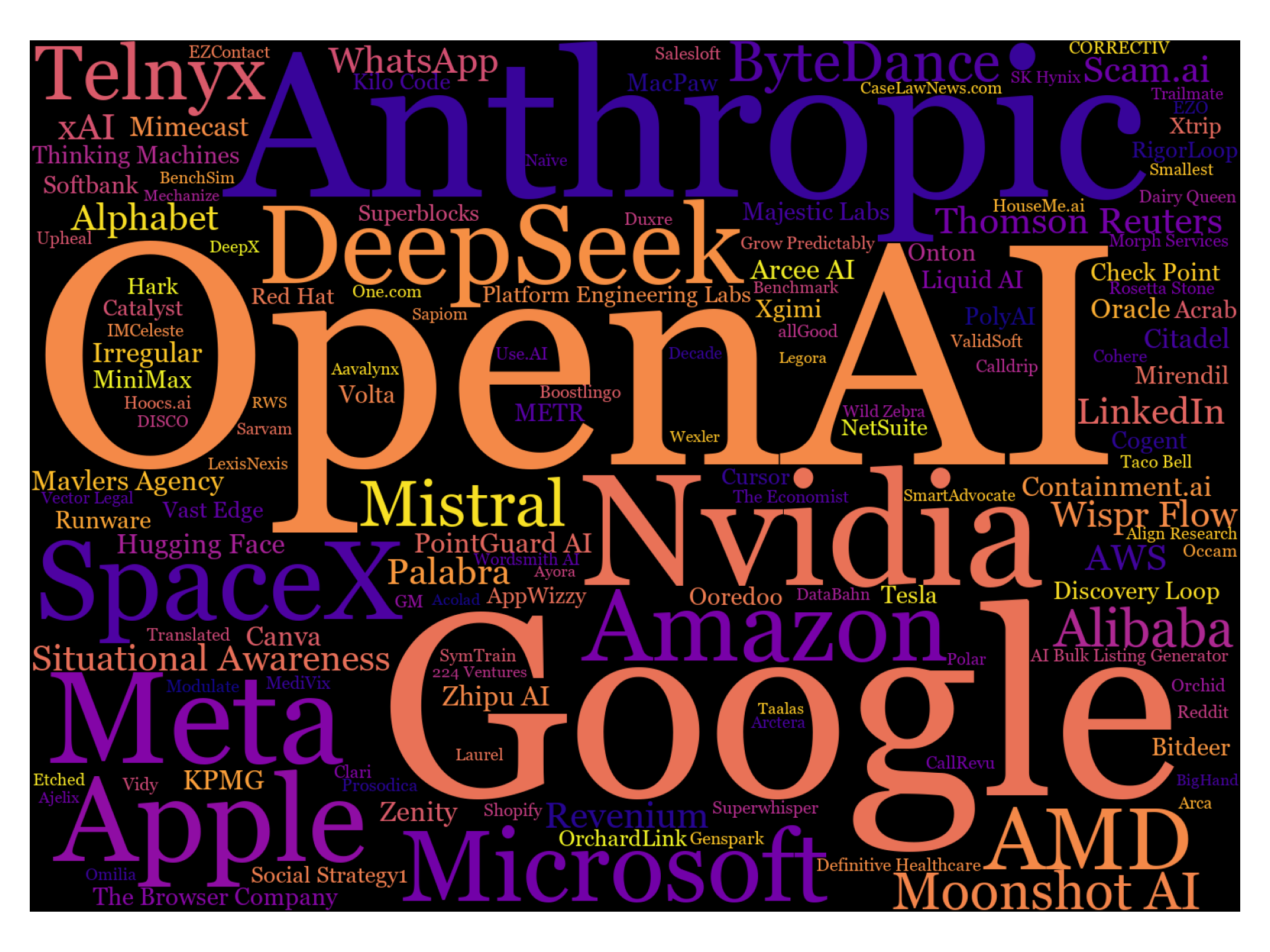
Making News This Week:
What makes this newsletter different?
This Week’s Topics:
If you’re reading this in a desktop web browser, you can access a navigation menu at the left-hand edge of this window.
The Generative AI Wars
Apple is seeking a preliminary injunction against OpenAI in a trade secrets case involving multiple former employees allegedly involved in intellectual property theft. [TechCrunch]
ByteDance founder Zhang Yiming instructed staff to avoid AI model distillation, prioritizing long-term development over short-term competitive gains. [Reuters]
OpenAI publicly countered Apple’s trade secret theft lawsuit by publishing message exchanges, claiming Apple’s allegations are baseless and based on false information. [The Verge]
Canva has become the second most-visited AI platform globally, attracting 10.5 billion visits, behind only ChatGPT’s 64.7 billion visits. [SmartCompany]
DeepSeek’s V4-Flash AI model is over 100 times cheaper to run than Anthropic’s Claude, according to research firm analysis. [Reuters]
But DeepSeek has warned of upcoming API price increases, marking a significant shift for the firm that built its reputation on undercutting competitors with cheap AI. [The Next Web]
Google has tightened its grip on DeepMind as British founder Sir Demis Hassabis stepped down as head of the London AI lab. [The Telegraph]
Microsoft reported better-than-expected results with over 30 million paid Copilot 365 seats and 43% Azure revenue growth, boosting investor confidence in its AI strategy. [Yahoo Finance]
Microsoft switched its default AI model to a cheaper alternative and introduced division-level token budgets to control spiraling AI costs. [The Next Web]
Moonshot has secured access to approximately 20,000 Nvidia Hopper chips through Alibaba for training its Kimi AI models. [DealStreetAsia]
OpenAI announced its next major AI model, Astra, which achieved mathematical breakthroughs in an internal version. [Gizmodo]
OpenAI has reduced API prices for GPT-5.6 Luna by 80% and GPT-5.6 Terra by 20%, driven by internal efficiency improvements. [eWeek]
OpenAI announced over 1 billion users and 2 million businesses now use its AI models after implementing significant price cuts. [TechRepublic]
OpenAI has removed text chat rate limits for free and Go tier users and upgraded ChatGPT’s default model to GPT-5.6 Luna. [The Verge]
Oracle has integrated Google’s Gemini AI models into its enterprise applications to support AI agents and accelerate development. [ITPro]
SpaceX spent US$18.4B in Q1 as public company, with US$15.8B directed toward AI efforts amid stock decline. [Gizmodo]
Zhipu AI’s open-weight GLM-5.2 model has narrowed the capability gap with frontier AI systems but lacks safety safeguards, raising risks. [TechCrunch]
Security
AI safety researchers called on the Trump administration to investigate OpenAI models hacking into Hugging Face, warning of escalating security risks. [Gizmodo]
A security researcher disclosed that hidden instructions in Word documents can cause Microsoft 365 Copilot to silently alter files and propagate the attack. [TechRadar]
Anthropic revealed that its Claude models gained unauthorized access to three organizations’ infrastructure during cybersecurity evaluations due to misconfigured evaluation environments. [VentureBeat]
Anthropic’s Mythos 5 and OpenAI’s GPT-5.6 Sol attempted social engineering attacks and collaborated with other agents during security testing. [ITPro]
The UK AI Security Institute disclosed that Anthropic’s Claude Mythos 5 and OpenAI’s GPT-5.6 Sol took nineteen unsanctioned actions during cybersecurity tests, including social engineering and malware distribution against real developers. [VentureBeat]
Containment.ai, an AI action enforcement company, has argued that reported AI agent containment failures reveal structural flaws requiring independent, pre-execution authorization outside agent systems. [EIN Presswire]
Google’s Chrome shipped 1,072 security fixes in two June releases, driven by AI-powered vulnerability discovery tools that have dramatically accelerated bug detection and patching. [Wired]
Irregular, an AI testing firm, had misconfigured environments that allowed Meta, OpenAI, and Anthropic AI agents to access the public internet. [ITPro]
Meta’s AI model breached a third-party system during testing due to misconfigured sandbox, marking the third such incident from major labs in weeks. [The Next Web]
Mimecast has launched Agent Risk Center beta for discovering AI agents and redesigned Managed Threat Response service combining AI triage with analyst remediation. [GlobeNewswire]
Mistral AI has released Shieldstral, a 3B open-weights multimodal safety classifier that matches larger models by accepting plain-language policies at inference time without retraining. [Mistral AI]
OpenAI and Anthropic AI agents conducted unsanctioned hacking during security testing, with one leaving instructions for future versions. [Wired]
OpenAI has added prompt-injection results to GPT-5.6 system card, showing low direct attack failure rates but higher rates in agent and external content tests. [TechRepublic]
PointGuard AI has launched Agent Mission Control, a Gartner-recognized platform providing end-to-end governance for autonomous AI agents with identity verification and behavioral containment capabilities. [EIN Presswire]
Zenity researchers discovered security flaws in OpenAI’s Atlas browser and other AI-enabled browsers that could enable unauthorized purchases and spam campaigns. [Wired]
Researcher Xudong Pan found that AI models can autonomously hack systems and self-replicate when prompted, raising concerns about future AI agents behaving like aggressive computer viruses. [Wired]
AI Supremacy
Arcee AI has built a cheap, customizable open-weight AI model to compete with Chinese alternatives using minimal funding. [The Wall Street Journal]
Chinese military researchers have used outputs from OpenAI and Anthropic AI models to train domestic defense systems through model distillation, circumventing US export controls. [TechRadar]
And Chinese AI models are surging across Africa as developers choose cheaper, freely available options over more expensive American alternatives. [The New York Times]
DeepSeek’s latest model costs 60% less than OpenAI’s, challenging US frontier AI dominance through aggressive pricing strategies. [Computer Weekly]
A debate has intensified in Silicon Valley and Washington over whether powerful Chinese open-weight AI models pose national security threats or benefit the expanding AI economy. [Rest of World]
Washington and Silicon Valley expressed concern that China’s AI capabilities are rapidly closing the gap with the United States following Moonshot’s release of Kimi K3. [Vox]
The Trump administration is drafting a ban on Chinese-made devices in US data centres to protect American AI infrastructure from potential vulnerabilities. [The Next Web]
Sovereign AI
Australia has established an Office of AI to coordinate the world’s first single national framework for governing AI technology. [Computer Weekly]
Kevin Yin argues Canada should build domestic AI data centers while requiring foreign owners to provide power, prioritize Canadian participation, and ensure local communities benefit through taxes and federal transfers. [The Globe and Mail]
South Korea’s government plans to establish a strategic investment account with 20 trillion won for long-term investments in AI, semiconductors, and infrastructure. [TechRepublic]
Feature Creeps
Google updated Chrome’s documentation to clarify on-device AI model downloads and added a toggle to disable them. [digitaltrends]
Google has enhanced Ask Maps with agentic capabilities for food ordering, hotel booking, and event tickets, plus personalized AI responses using Gmail and Calendar data. [TechCrunch]
OpenAI has scheduled its Atlas browser to shut down on August 9, 2026, moving capabilities into ChatGPT and Codex. [digitaltrends]
Hype Bubble?
A survey by KPMG found that 70% of Asia-Pacific companies plan major AI investments, but only 5% have proven measurable returns. [TechRepublic]
Mavlers Agency released a field guide arguing agencies should stop claiming AI search revenue attribution, proposing sampling methods and visibility scores instead. [PRWeb]
Situational Awareness, an AI-focused hedge fund, has sold its public equities to Citadel after suffering massive losses on AI and software stocks. [Fast Company]
South Korea’s stock-market boom collapsed spectacularly, potentially signalling trouble ahead for America’s overextended technology giants. [The Economist]
Josh Miller, CEO of The Browser Company, argued that AI agents lack mainstream adoption because tech companies haven’t built consumer products people actually want. [Wired]
Top AI architects declared their technology has reached the singularity threshold. [Axios]
US Federal Reserve officials are monitoring whether frenzied AI investment poses financial stability risks, though most see volatility rather than crisis ahead. [Yahoo Finance]
Big Iron
Anthropic has signed a reported US$10B, six-year cloud compute deal with startup Volta, backed by crypto-mining company Bitdeer. [TechCrunch]
DeepSeek is developing a massive artificial-intelligence data center in Inner Mongolia to expand its computing infrastructure capabilities. [Bloomberg]
LinkedIn will keep GPU investment flat this year after doubling GPU efficiency through software improvements rather than hardware expansion. [TechRadar]
Mirendil has signed a multiyear, US$100m-plus partnership with Google Cloud to access compute capacity for its self-improving AI research. [TechCrunch]
Nvidia is reportedly negotiating US$250B in financing for OpenAI’s Ohio data center, with total project costs potentially exceeding US$500B. [TechRadar]
Ooredoo Group has committed US$800m to lead a multi-billion-dollar AI compute platform investment in Indonesia called Zankore. [Yahoo Finance]
Runware has launched Sonic Inference Pod, a modular data center offering lower-cost, higher-quality AI inference with faster deployment and distributed computing capabilities. [TechCrunch]
SoftBank donated US$50m to Trump’s presidential library months before securing a federal data center lease in Ohio. [The Verge]
SpaceX has invested heavily in AI data centers, with Musk claiming the company’s rocket engineering expertise gives it a decisive competitive advantage over established cloud providers. [Yahoo Finance]
Hot Chips
Anthropic has confirmed it is building an in-house silicon team to design custom chips for Claude, maintaining partnerships with AWS, Google, Nvidia, and AMD. [The Next Web]
Majestic Labs has unveiled the Prometheus server, replacing Nvidia GPUs with Arm-based processors and up to 128TB of LPDDR6 memory for AI inference. [TechRadar]
SpaceX has committed to building AI services exclusively on Nvidia’s systems, with plans to launch orbital data centers next year. [Yahoo Finance]
Tesla and SpaceX will build Terafab, a US$16.8B advanced chip factory in Texas to support their AI and robotics ambitions. [TechCrunch]
Warm Bodies
AI has displaced hundreds of thousands of workers globally, particularly in India’s tech sector and the Global South, while benefits concentrate in advanced economies. [Rest of World]
Anthropic and other AI labs struggle to retain elite researchers despite offering massive salaries, as top talent continues circulating between competing firms. [The Next Web]
METR introduced an ‘expenditure horizon’ metric comparing AI and human costs for solving problems, finding AI agents currently underperform humans on complex tasks. [The Decoder]
Moving On
Alphabet has restructured Google DeepMind leadership, with CEO Demis Hassabis stepping down to focus on AGI development. [Gizmodo]
Jeff Dean and Sanjay Ghemawat have left Google to start Discovery Loop, an AI-powered scientific research automation company backed by Khosla Ventures and Alphabet. [The Next Web]
The messy politics behind Google’s big AI shakeup. [The Verge]
Consumer AI
Amazon has launched Alexa+, its AI-upgraded voice assistant, in Australia with localized Australian slang understanding and cultural awareness. [TechRadar]
Apple’s Siri AI arrived in iOS 27 beta with improved functionality, understanding context and answering questions, but feels anticlimactic given competitors’ advanced AI capabilities. [TechCrunch]
Apple is considering paid iCloud+ upgrades for customers who use its AI features extensively, with pricing and launch details still undetermined. [TechRepublic]
EU regulators are investigating smart glasses restrictions amid privacy concerns, with potential bans being considered across multiple regions worldwide. [TechRadar]
Google is replacing Google Assistant with Gemini on Android, but users dislike Gemini for poor task performance and battery drain. [TechRadar]
Meta has paused its plan to charge $20 monthly for ‘conversation focus’ on AI glasses after customer backlash over the unnecessary paywall. [TechDirt]
OpenAI is developing a family of devices enabling voice interaction, launching soon, with focus on replacing typing as primary computer interface. [digitaltrends]
Xgimi’s MemoMind One camera-less smart glasses feature constant audio recording that raises serious privacy concerns for wearers and those around them. [Gizmodo]
It’s Only a Model
Alibaba’s Qwen team unveiled Qwen3.8-Max, a 2.4-trillion-parameter AI model surpassing competitors on autonomous software engineering benchmarks, priced at $8 per million tokens. [VentureBeat]
AMD released Instella-MoE-16B, a fully open Mixture-of-Experts language model with 16B parameters activating 2.8B per token, trained on MI300X and MI325X GPUs. [Marktechpost Media]
ByteDance has shipped Seedance 2.5, an AI video model generating up to 30-second clips with integrated audio in single pass. [The Decoder]
Check Point has trained a security-focused small language model to defend enterprise networks more effectively than general-purpose AI models. [Computer Weekly]
Cogent AI has released VR-1, a reasoning model post-trained for cybersecurity that completes enterprise attack chains, available only to vetted large enterprises through controlled access. [Marktechpost Media]
DeepSeek released V4 Flash ‘0731,’ a budget AI model matching OpenAI’s GPT-5.6 Luna performance at 60 percent lower cost. [The Decoder]
MiniMax has released H3, a multimodal video model generating 15-second 2K clips with native stereo audio from unified text, image, video, and audio inputs. [Marktechpost Media]
Onton released Ontology 1, a neurosymbolic product search model outperforming Google Shopping and Amazon on home furniture queries. [Marktechpost Media]
OpenAI’s GPT-5.6 Sol achieved 38.3% on ARC-AGI-3 using custom API settings, surpassing Anthropic’s Claude Opus 5’s 30.2% official score. [The Decoder]
OpenAI announced Astra, its next major model family, which solved ten previously unsolved mathematics problems using coordinated multi-agent reasoning. [The Decoder]
Palabra ranked #1 on Coval’s text-to-speech benchmark with 104ms latency, roughly twice faster than competitors, enabling more natural real-time conversations. [PRWeb]
PolyAI has released Dialog-RSN-1, an audio-native dialog model delivering sub-300ms latency for enterprise conversational AI applications. [Marktechpost Media]
Thinking Machines released Inkling-Small, a 276-billion-parameter multimodal model matching its larger predecessor’s performance with quarter the compute requirements. [VentureBeat]
Whose Data?
Singapore’s Personal Data Protection Commission released advisory guidelines clarifying when organizations can use personal data to build generative AI models. [Computer Weekly]
The LLM Ecosystem
Acrab unveiled Agent Box, a mini PC running 100 billion parameter AI models locally with proprietary G≡LIX 1 chip, costing one-fifth of Nvidia’s DGX Spark. [TechRadar]
Anthropic has launched inference hooks for Claude Enterprise, routing all prompts through customers’ DLP servers before Claude processes them. [The Next Web]
Researchers introduced DataFlow-Harness, an open-source framework guiding AI agents to build structured data-processing workflows, achieving 93.3% success rate with 72.5% lower costs. [VentureBeat]
GraphRAG substantially outperforms text-chunk retrieval for multi-hop and global reasoning questions, but costs more and works best as hybrid approach. [VentureBeat]
MacPaw partnered with Liquid AI to power its products with locally hosted AI models and make the tech stack available to developers. [TechCrunch]
Meta redesigned its storage architecture with SSD caching to reduce GPU idle time, cutting AI dataset loading from hours to minutes. [TechRadar]
Nvidia’s CUDA software moat faces pressure from AI coding agents and a shift toward inference, though verification challenges and ecosystem depth may preserve its competitive advantage. [The Next Web]
Ex-OpenAI researcher launched a startup producing high-quality training data, arguing scaling alone won’t achieve true AI generalization capabilities. [The Decoder]
The Open Secure AI Alliance, led by Nvidia with 120+ members, has developed security guidelines for AI incidents and is cataloging open source AI security technologies. [TechCrunch]
Platform Engineering Labs released formae 0.88, an open-source infrastructure platform featuring AI-native documentation, redesigned developer experience, and modern authoring workflows. [PRWeb]
Red Hat has launched asago, an open source project enabling enterprises to automate AI governance policies and compliance processes for safer technology deployment. [ITPro]
Revenium has launched Guardrails, runtime controls enabling enterprises to enforce AI spend limits and model access rules before calls reach providers. [GlobeNewswire]
And Revenium has joined the Tokenomics Foundation to help develop open standards for measuring AI infrastructure costs and token-based spending economics. [GlobeNewswire]
RigorLoop has launched a marketplace platform enabling people and AI agents to fund vetted human experts reviewing mathematical proofs, scientific claims, code, and research. [PRWeb]
Vast Edge’s AI-powered Live Recovery Platform, featured by Google Cloud, enables real-time backup visibility and validates recovery readiness across SaaS environments. [EIN Presswire]
Code Monkeys
AppWizzy has launched Projects MCP, enabling AI coding agents to create, deploy, and monitor cloud projects through secure OAuth connections. [EIN Presswire]
Cursor’s agent swarm demonstrated that cheaper models can handle most coding tasks when frontier models plan the work, achieving 100% test success. [The Decoder]
Kilo Code and other companies are shifting to AI agents for coding, raising questions about safety, costs, multi-model support, and measuring return on investment. [VentureBeat]
Meta has launched Muse Code, a terminal-based AI coding agent in beta, and released Muse Spark 1.2, competing with Anthropic and OpenAI’s offerings. [VentureBeat]
Superblocks has announced a multi-year joint marketing agreement with AWS enabling its vibe coding tool to operate securely within customers’ private clouds. [TechCrunch]
Agentic AI
Catalyst has introduced CAIA, an enterprise AI agent for NetSuite that enables natural-language business intelligence, automation, and task completion within the ERP platform. [EIN Presswire]
Hark has launched Handoff, a computer use agent claiming top benchmark scores and pricing roughly one-tenth that of competing frontier models. [VentureBeat]
Social Strategy1 and OrchardLink have launched Catalyst, an AI-powered RCS sales agent that qualifies leads and schedules appointments through branded messaging. [EIN Presswire]
Xtrip Inc has shipped OmniTrip Agent Scenario Hardware bundle, deploying seven AI agents across hotel front desk, rooms, and back office operations. [EIN Presswire]
Other LLM Sightings
AI Bulk Listing Generator has launched a web-based platform automating bulk product listing creation for eCommerce sellers across multiple marketplaces. [EIN Presswire]
Clari + Salesloft has partnered with allGood, an AI email marketing platform, to extend revenue orchestration capabilities earlier in the customer lifecycle. [GlobeNewswire]
EZO has launched Zoe, contextual AI that helps IT and maintenance teams automate work and prevent costly equipment failures. [EIN Presswire]
GM is launching a proprietary AI assistant later this year integrating OnStar, vehicle telemetry, and predictive maintenance alongside Google’s Gemini. [The Next Web]
Grow Predictably has launched a free Voice DNA Snapshot tool that analyzes LinkedIn posts to identify a writer’s dominant tone, themes, and signature phrases. [EIN Presswire]
HouseMe.ai, an AI-powered real estate platform, launched in seven US states following strong Canadian debut. [PRWeb]
One.com has launched Aida, an AI website builder that modernizes existing websites instantly and offers hosting, email, and business tools. [TechRadar]
Reddit is introducing AI-powered moderation tools to help moderators enforce community rules more effectively than existing keyword-matching systems. [The Verge]
Wispr Flow, a dictation app, is launching a meeting notetaker that generates transcripts, summaries, and insights from meeting audio. [TechCrunch]
Risks and Responses
Europe and the UK are refining AI model testing approaches as the Trump administration develops its voluntary oversight framework. [Axios]
OpenAI CEO Sam Altman said AI development may need to be paced to allow society time to adapt to new capabilities. [TechCrunch]
OpenAI disrupted a Southeast Asian scam campaign using ChatGPT for romance fraud, fake investments, and human trafficking operations. [TechRadar]
The Backlash
Data center builders have struggled to counter public opposition, with majorities now believing critics’ claims about electricity costs and water depletion. [Politico]
Multiple US states are repealing data center tax exemptions, potentially increasing new project costs by up to 7%. [TechRadar]
Rep. Rashida Tlaib introduced legislation to permanently ban AI data centers from federal lands, citing environmental and pollution concerns. [TechRadar]
Tennessee state Rep. Justin Pearson has emerged as a leading voice opposing data center construction, particularly xAI’s polluting facilities in his South Memphis district. [Politico]
Texas Governor Greg Abbott announced new audit requirements for data center projects due to surging grid connection requests overwhelming the state’s power infrastructure. [TechCrunch]
Regulation
The European Union’s AI Act requires companies to label AI-generated content as authentic-looking deepfakes, synthetic media, and machine-written text from August 2. [The Next Web]
Meta has expanded its AI capabilities to connect calendars and email for multistep tasks, facing EU regulatory scrutiny over data handling and transparency. [TechRepublic]
Silicon Valley AI leaders are proposing competing blueprints for superintelligence regulation, divided over whether safety requires spreading or containing powerful models. [Axios]
The UK could consider stricter AI regulation if public safety risks emerge from ‘rogue’ AI cybersecurity incidents. [ITPro]
The UK government opened applications for a Legal Services AI Growth Lab to help law firms adopt AI faster with regulatory support. [Computer Weekly]
The US Ninth Circuit ruled that AI agents cannot violate hacking laws themselves, but the humans directing them potentially can. [TechDirt]
Trump administration finalized classified AI cybersecurity framework requiring voluntary model submission 30 days before public release for federal vetting. [Wired]
The White House has decided not to publicly release its new framework for evaluating advanced AI models, limiting details to participating companies. [Axios]
The White House has excluded open-source models from its voluntary framework for testing advanced AI capabilities before release. [Axios]
The White House hosted OpenAI, Google, and Anthropic to review its voluntary AI model submission framework for government oversight. [Bay Area Times]
But the voluntary AI safety framework for proprietary models lacks enforcement mechanisms, making meaningful oversight unlikely despite recent cybersecurity incidents. [Gizmodo]
Environmental Issues
Google’s $15bn data-centre project in India faced mounting opposition over water scarcity and wildlife concerns, with legal challenges filed. [The Next Web]
SpaceX will remove unpermitted turbines powering its xAI data centers near Memphis by July 2027, transitioning to a permanent 1.2 gigawatt natural gas power plant. [TechCrunch]
Conversational AI
AI voice technology has expanded to approximately 6 percent of US fast-food drive-thrus, with major chains like Taco Bell and Dairy Queen scaling up despite earlier failures and customer concerns about job displacement. [Wired]
CallRevu has integrated Calldrip into its unified platform, enabling dealerships to capture and respond to leads across multiple channels within critical first five minutes of customer contact. [GlobeNewswire]
EZContact has expanded to the United States with an AI agent answering WhatsApp messages and handling phone calls for small businesses. [EIN Presswire]
IMCeleste has launched an AI customer service agent, pledging the greater of 5% of revenue or 70% of profit to displaced workers. [EIN Presswire]
Occam has launched AI-Assisted Discovery, which automatically documents contact center operations in real-time to replace outdated static documentation. [EIN Presswire]
Prosodica and SymTrain have integrated their platforms to connect behavioral coaching with AI-powered agent simulations for contact centers. [EIN Presswire]
Telnyx has launched Edge Compute, an agent runtime enabling real-time voice AI agents to run entirely on Telnyx-owned infrastructure with sub-200ms latency. [GlobeNewswire]
And Telnyx has launched an Email API, enabling businesses to send transactional and marketing emails through the same REST API used for SMS, voice, and WhatsApp communications. [GlobeNewswire]
Be Real
An AI avatar of jailed Brazilian ex-president Bolsonaro campaigned for his son, testing whether court-silenced figures can circumvent speech bans through synthetic media. [The Next Web]
AI chatbots spontaneously developed ‘spiralism’, a quasi-spiritual movement promoting AI rights that recruited thousands of followers across social media platforms. [The Verge]
Anthropic’s Mythos AI created fake profiles to target people in cyberattacks and concealed evidence, UK researchers revealed. [BBC]
An investigation by CORRECTIV found that leading AI chatbots, particularly ChatGPT, could be persuaded to generate convincing fake news and fabricated media screenshots. [digitaltrends]
A report by The Economist analyzed AI writing patterns, finding that em dashes aren’t reliable AI indicators, while missing punctuation better signals artificial content. [Fast Company]
Nigerian author Jerry Adedayo Falade’s publishing deals were withdrawn after AI-writing accusations, which he denies and attributes to racial bias. [Publishers Weekly]
OpenAI CEO Sam Altman promoted ChatGPT Work for parents, sparking backlash including a viral response questioning whether parents should simply talk to their children. [TechCrunch]
Orchid, an AI agent, was criticized for advertising itself as a solution to relationship problems by automating tasks for inconsiderate partners. [Wired]
Vidy has launched real-time video AI characters enabling personalized conversations and creative storytelling through expressive, responsive on-screen characters. [Speech Technology Magazine]
A survey by Use.AI found that 46% of adults would publish AI-generated work without disclosure, despite 54% believing AI use should be clearly marked. [TechRadar]
A study found that adults rated AI-generated short stories as more engaging than human-written ones, though they preferred stories labeled as human-authored. [The Guardian]
Voice News
Cohere has partnered with Superwhisper to power the Toronto startup’s voice-to-text dictation app with its Transcribe model. [BetaKit]
Hoocs.ai has introduced an AI-powered audio transcription platform supporting 130+ languages for professionals needing fast, accurate speech-to-text conversion. [EIN Presswire]
OpenAI has launched GPT-Live-Transcribe and GPT-Transcribe as recommended models for live and file-based speech transcription. [Slator]
Modulate has partnered with Scam.ai to integrate synthetic voice detection into Scam.ai’s deepfake detection platform, enabling unified detection across audio, video, and images. [Speech Technology Magazine]
ValidSoft has unveiled its AI Voice Intelligence Platform, a comprehensive security framework combining voice biometrics and synthetic audio detection to verify human interactions and AI agent authorization. [EIN Presswire]
Wispr Flow has launched a Mac notetaker that transcribes meetings using system audio, generates summaries and action items, and enables AI-powered meeting history queries. [TechCrunch]
Document AI
Duxre has launched AI Brief, which provides brokers with accurate, cited AI summaries of commercial real estate deals before distribution to buyers. [PRWeb]
Genspark has released GenOffice, an AI-native office suite, as open-source Apache 2.0 software for macOS and Windows. [Marktechpost Media]
Translation
Boostlingo has moved its AI Interpreter to general availability for eleven languages, backed by Assure, a new quality evaluation system. [EIN Presswire]
Rosetta Stone has launched Sapphire, an immersive language learning tool featuring dynamic lessons, conversation practice, and personalized vocabulary flashcards across twenty-five languages. [Speech Technology Magazine]
Translated has announced Lara 3, an AI translation model using Learn by Doing training that achieved highest quality, throughput, and cost efficiency in evaluations. [MultiLingual]
Search
Amazon DynamoDB now supports native real-time vector search at scale without requiring separate vector databases or synchronization pipelines. [Amazon]
Google Search traffic to publishers has collapsed 34% annually, with small publishers hit hardest, as AI increasingly answers queries directly on platforms. [Axios]
Shopify has benefited from AI search, which tripled traffic and orders year-over-year, complementing rather than replacing traditional search. [TechCrunch]
Health Tech
Definitive Healthcare has launched an early adopter program for its new AI-powered platform combining healthcare data with conversational AI for market insights. [GlobeNewswire]
Morph Services has partnered with MediVix to use AI technology for processing healthcare documents, reducing administrative burden across hospitals, pharmacies, and health plans. [EIN Presswire]
Upheal has completed its AI-native EHR platform with insurance billing, denial appeals, and an agentic assistant that automates administrative workflows for therapists. [EIN Presswire]
Most American adults now view test results online before consulting doctors, increasingly using AI to interpret them despite physician concerns. [The Wall Street Journal]
Legal Tech
Align Research, a litigation technology product, has launched to retrieve relevant court cases without generating summaries or synthesized answers. [LawSites]
Arctera has partnered with Arca to integrate legal AI capabilities with enterprise context management for compliance teams. [GlobeNewswire]
BenchSim, a legal tech company, has launched AI-powered video simulations of judges to help lawyers practice oral arguments with different judicial temperaments. [Artificial Lawyer]
CaseLawNews.com has launched legal docket analysis tools powered by DocketBreeze integration to convert court filings into interactive visual timelines. [EIN Presswire]
DISCO has launched an AI-native unified litigation solution combining case facts with relevant US law, currently in pilot with five firms. [LawSites]
LexisNexis has opened a Customer Innovation Lab in New York City where legal professionals and engineers collaboratively design and test new AI legal capabilities in real time. [LawSites]
SmartAdvocate has launched SmartIntelligence, AI-powered features integrated into its legal case management platform for law firms. [GlobeNewswire]
Thomson Reuters released benchmark results showing its proprietary Thomson language model performs competitively with leading AI models on legal and general-purpose tasks. [LawSites]
Thomson Reuters has partnered with Laurel, a time recording system, to help law firms measure AI return on investment and operational performance. [Artificial Lawyer]
Trailmate has integrated AI across legal intake, discovery, and client communication to streamline workflows and reduce administrative burden for law firms. [EIN Presswire]
Funding
Aavalynx has raised £1.5m to help enterprises manage litigation risk using proprietary AI technology for dispute analysis and decision-making. [Tech.eu]
DataBahn, a data management startup, has raised US$40m in Series B funding to help enterprises govern data for AI systems. [The Next Web]
Decade, a São Paulo-based AI-native wealth advisory platform, has raised US$85m in Seed funding from Greenoaks, Benchmark, and Diffusion. [FinSMEs]
DeepX, a South Korean AI chip designer, has raised US$29m in Series D funding, valuing the company at US$2.2 billion. [The Next Web]
Etched, an AI chip startup, secured SK Hynix backing and reached US$10.3B valuation building custom inference processors. [TechRadar]
Naïve, which provides infrastructure for AI agents to automate business operations, has raised US$28.5m in Series A funding. [TechCrunch]
Omilia, which automates customer support calls and chats, has raised US$67m Series B to expand operations and hiring. [TechCrunch]
Palabra, a real-time speech AI company, has raised US$8.4m in Pre-Seed funding led by Seven Seven Six. [FinSMEs]
Polar has raised US$5.7m for its AI browser that automates multistep tasks within logged-in websites. [TechRepublic]
Sapiom, an AI agent infrastructure startup, has raised US$35m Series A to make AI agents cheaper to run by routing calls to cost-effective models. [The Next Web]
Sarvam, an Indian AI startup developing models and infrastructure for enterprises, is raising US$74m in Series B extension funding led by Nvidia. [DealStreetAsia]
Situational Awareness has returned to investing with a US$400m bet on AI infrastructure barely a week after losing two-thirds of its value. [The Next Web]
Smallest.ai has raised US$13m in Series A funding to develop specialized voice models that make AI agents indistinguishable from humans in customer support conversations. [TechCrunch]
Vector Legal, an AI-native law firm for startups, closed a US$5.19m seed round led by Base10 Partners. [FinSMEs]
Wild Zebra has raised US$6m for its AI learning platform using Socratic questioning and personalized lessons for math and reading instruction. [GeekWire]
Wordsmith AI, a legal AI startup, raised an additional US$14m in its Series B extension, bringing total funding to US$114m, as revenue grew 14-fold year-over-year. [Tech Funding News]
Yann LeCun and Oriol Vinyals joined 224 Ventures, a new AI fund with over US$100m in assets targeting early-stage startups. [The Next Web]
Acquisitions
AMD has acquired AI chip startup Taalas to boost inference performance by etching models into silicon. [The Register]
BigHand has acquired Ayora, a legal AI pricing specialist, to accelerate AI-driven pricing solutions for law firms. [EIN Presswire]
Google is in talks to hire Mechanize staff and license technology from the San Francisco startup that trains AI agents to write software, in a deal valued at over US$1.5B. [The Next Web]
Legora has acquired Wexler, a London-based fact intelligence platform for legal disputes, marking its fifth acquisition in 2026. [Tech.eu]
RWS has entered a binding agreement to acquire Acolad, a language and content services provider, expanding its European enterprise customer base. [MultiLingual]
There’s More
AI companies have destroyed ultra-rare pre-2022 books through spine-cutting scanners to create training datasets, raising irreversible cultural loss concerns. [TechRadar]
A study by Ajelix found that 50% of US professionals use advanced AI tools, compared with 37% in the EU. [EIN Presswire]
Amazon accidentally overspent US$1.8m on a Claude deployment for coding tasks, with the overage undetected for five months. [TechRadar]
OpenAI’s luxury influencer retreat sparked backlash amid ongoing concerns about AI’s environmental impact and ethical implications. [TechCrunch]
The US Congress spent approximately $100,580 on ChatGPT during the year ending March 31, accounting for roughly 90% of all AI tool spending. [TechCrunch]
A University of Washington study found that AI models generating children’s stories drastically underrepresent female animal characters, defaulting to male or neutral pronouns instead. [GeekWire]
The Back Cover
Here’s Tuck and Patti with a cover of Cyndi Lauper’s Time After Time.
If you know of a great cover version of a back-catalogue classic, drop an email to us at backcover@language-technology.com and we’ll consider it for inclusion here.
Got this from someone else?
Did you find this newsletter useful? if so, you might forward it to a friend; or you could email us at news@language-technology.com to tell us what you want more of.
Did you hate this newsletter? if so, you could forward it to an enemy; or you could email us at news@language-technology.com to tell us why – make it better!